Builders, contractors, hardware stores and homeowners buy by the metre or by the sheet, often for delivery the same day or the next, so location, stock and service matter. Coil prices changed in 2026, when ITAC announced anti-dumping duties of 8.21–57.84% on corrosion-resistant coated steel from China, applying from 18 September 2026, so compare local and imported coil delivered to your yard. You also need a yard with crane or forklift capacity, three-phase power and space for coils and finished sheets. CISH supplies, installs and commissions roll forming lines for roofing yards.
Step 1: choose your profiles
| Profile | Where it sells | Notes |
|---|---|---|
| IBR | Houses, outbuildings, commercial and industrial roofs | The most common profile; check local dimensions |
| Corrugated | Houses, low-cost housing, farm buildings | Traditional; popular in many areas |
| Double-layer machine | Both profiles on one frame | Saves floor space and capital |
| Ridges, flashings, gutters | Every roof | Extra machines or a folder add sales |
Ask builders and hardware stores in your area which profile, gauge and colours they buy most. Start with that. Our guide to choosing a roll forming machine explains the options.
Step 2: coil supply and the anti-dumping duties
Coil is your largest cost by far. You buy galvanised (zinc-coated), zinc-aluminium coated or pre-painted steel coils in the widths, thicknesses and colours your market wants. ITAC announced anti-dumping duties of 8.21–57.84% on corrosion-resistant coated steel from China from 18 September 2026, which changes the price of imported coil. Get quotes for local and imported coil delivered to your yard, ask about lead times, and keep stock for a few weeks of sales. Thickness and coating class must match what you advertise; customers and inspectors check.
Step 3: machines and costs
| What you buy | Indicative price (2026) |
|---|---|
| Single-profile roll former (IBR or corrugated) | About US$11,000–35,000 ex-works |
| Double-layer machine (two profiles) | About US$25,000–50,000 and more |
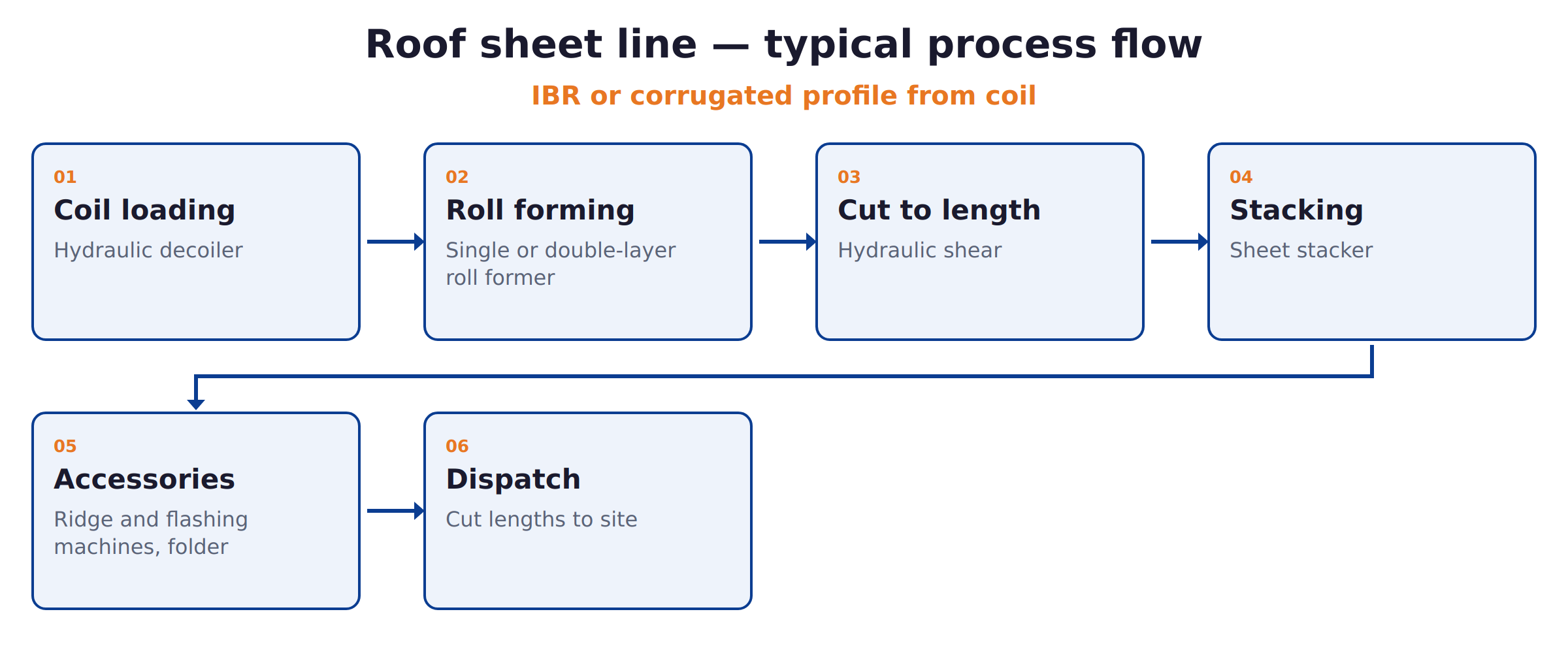
| Complete line with hydraulic decoiler, cut-to-length, stacker | Quoted per configuration |
| Ridge and flashing machines, folder | Priced per machine |
A manual decoiler suits a demonstration; a hydraulic decoiler rated for the coil weights you buy suits a business. Machines quoted for a wide gauge range usually form best in the middle of it, so test the gauge your market buys before shipping. Our roofing sheet machine price guide shows the bands.
Step 4: the yard
- Space: for coils, the machine line (long enough for the longest sheets), finished stock and loading.
- Handling: a crane or forklift rated for your coil weights.
- Power: three-phase supply for the machine and hydraulics.
- Cover: a roof over the machine and coil store to protect from rain.
- Access: for coil trucks and customer bakkies and trucks.
- Location: near builders and on a route customers use.
Step 5: selling
Roofing yards sell by the metre or by the sheet, cut to length, with delivery. Customers include building contractors, housing developers, hardware stores, farmers and homeowners. Offer a quick quotation service from roof plans, same-day or next-day cutting, delivery, and the accessories every roof needs: ridges, flashings, screws, purlins and insulation. Builders come back to yards that are reliable and fair.
The numbers
Margin per metre is the selling price less coil cost per metre (by gauge and coating), scrap from offcuts, power, labour, delivery and finance. Coil cost dominates, so buying well and keeping scrap low matter most. Track sales and margin by profile, gauge and colour, and avoid stocking colours that sell slowly.
Worked example: a roofing yard in Limpopo
A hardware store owner in Polokwane buys roof sheets from a distant supplier and waits days for deliveries. She buys a double-layer IBR and corrugated machine with a hydraulic decoiler, a ridge machine and a forklift, and sets up a covered yard behind the store. She buys galvanised and two pre-painted colours of coil, cuts to order for builders and homeowners, and delivers with her own truck. After a year, she adds a gutter machine. The figures are illustrative.
Quality and standards
Sheets should be formed accurately so they overlap and seal properly. Check profile dimensions against your drawings, coat thickness against what you sell, and cut ends for burrs. Builders working on homes enrolled with the NHBRC must use materials that meet the relevant standards and the roof designer's specification; contractors will ask for coil certificates.
Working capital
Coil stock, credit to builders and the time between buying coil and getting paid all tie up cash. Plan working capital for at least a few months, negotiate coil payment terms, and set credit limits for customers.
Safety
Coil handling, sharp sheet edges and the machine's shears are the main hazards. Guard the machine, provide gloves and protective clothing, train forklift and crane operators, and keep the yard tidy.
Common mistakes
- No coil plan: high prices and idle machine time.
- The wrong profile for your market.
- A manual decoiler for production work.
- Soft rollers that let the profile drift.
- Not enough yard space for coil and stock.
Accessories and services that bring customers back
A roof is more than sheets. Builders want one stop for ridges, valley and side flashings, barge boards, gutters and downpipes, roofing screws with washers, purlins or timber, insulation and sisalation. Stock the fast movers and offer the rest to order. A folder or brake press lets you make flashings to any shape a roof needs, and a ridge machine gives you the most common accessory from your own coil. Measuring and quoting from building plans, cutting sheets to exact lengths so builders do not waste steel, and delivering to site on a fixed day all build loyalty. Some yards also offer installation crews or recommend reliable roofers.
Planning for growth
Once one line runs well, the next steps are usually a second profile, a purlin or light gauge steel machine, or a second shift. Plan the yard and power supply so you can add a machine without moving everything, and keep coil purchasing disciplined as you grow: more profiles and colours mean more stock to finance.
Where CISH fits
We supply roll forming lines, IBR, corrugated and double-layer machines, hydraulic decoilers, cut-to-length and stacking, ridge and flashing machines, from audited factories in China, sized to your profiles and gauges. CISH ships, clears, installs and commissions the line on your coil, and trains your team. For a single used machine or roller repairs, a local workshop is usually the better buy.
Frequently asked questions
How do I start a roofing sheet business?
Choose the profiles your market buys, plan coil supply and working capital, set up a yard with handling and power, and buy a roll forming machine to match.
How much does a roofing sheet machine cost?
As an indication for 2026, a single-profile IBR or corrugated roll former costs about US$11,000–35,000 ex-works.
What is the biggest cost in a roofing sheet business?
Steel coil; a month of coil stock usually costs more than the machine.
Are there duties on coated steel coil from China?
Yes. ITAC announced anti-dumping duties of 8.21–57.84% on corrosion-resistant coated steel from China from 18 September 2026.
Which profile should I make first?
The one your local builders buy most, usually IBR or corrugated, or both on a double-layer machine.
Does CISH supply roll forming lines?
Yes, complete lines with commissioning and training.