A shredder or granulator alone, costing in the low tens of thousands of dollars, turns sorted clean waste into regrind for moulders. Adding a pelletiser (extruder) costs about US$80,000–120,000 more and turns flakes or film into pellets that bag and pipe makers can feed straight into their machines. Landed and installed, budget 25–45% above these ex-works figures. Plants above 500 m² usually need a waste management licence.
The short answer: choose by material
| Material you collect | What buyers want | Line you need | Indicative price (2026) |
|---|---|---|---|
| Clean factory scrap (sprues, rejects) | Regrind | Granulator or shredder | Low tens of thousands of US dollars |
| PET bottles | Clean flakes, sometimes food-grade | PET washing line: label removal, crushing, hot wash, friction wash, float-sink, drying | About US$150,000–200,000 for 500 kg/h |
| HDPE and PP rigids (crates, drums, containers, caps) | Clean flakes or pellets | Shred, wash, float-sink, dry; add pelletiser | US$120,000–350,000 for a 300–1,000 kg/h washing line, plus US$80,000–120,000 for pellets |
| LDPE and LLDPE film (shrink, stretch, bags) | Pellets | Film washing with squeezer or dryer, then pelletiser | Washing band plus pelletiser |
| Mixed, dirty plastics | Depends; often no buyer | Sort first; a line only for streams that sell | Do not buy a line for mixed waste |
Shredding only, washing, or pellets?
Shredding or granulating only
If your plastic is already clean and sorted, from factory scrap or a single customer's rejects, a granulator is all you need. Moulders buy regrind if it is the right material and colour.
Washing line
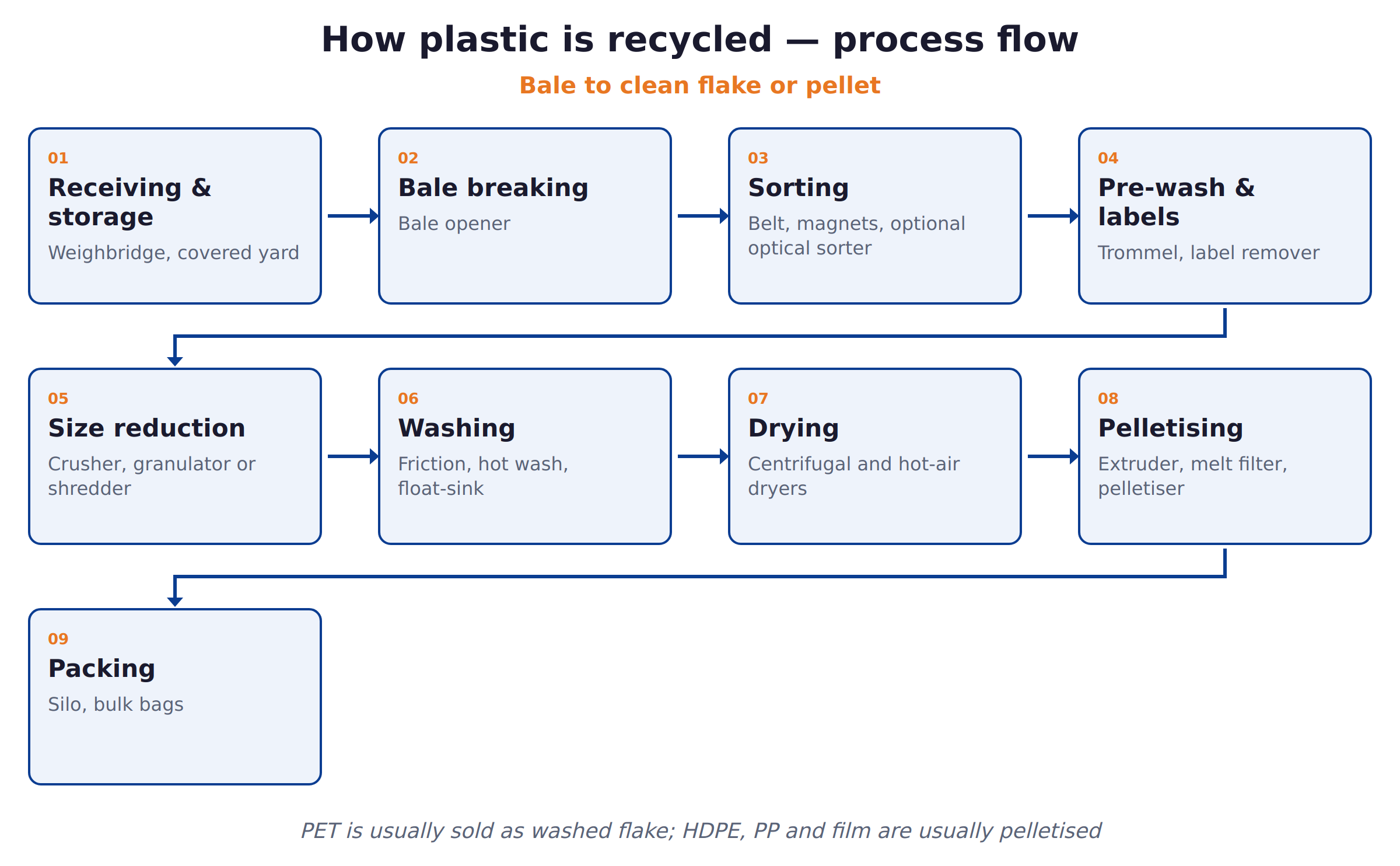
Post-consumer plastic carries labels, glue, dirt, food residue and mixed polymers. A washing line separates and cleans it: shredding or crushing, pre-washing, hot or friction washing, float-sink separation (PET sinks, PE and PP float), drying. Clean flakes sell to converters and exporters.
Pelletising
A pelletiser melts flakes or film, filters out contamination and cuts pellets. Many bag, film and pipe makers prefer pellets because they feed consistently. Pelletising adds value but also power use and skilled operation.
Size the line to collection, not to the brochure
Most recyclers run short of material before they run short of machine capacity. Start from tonnes a month you can collect reliably, and size the line for one shift of that volume with room to grow. A 500 kg/h line running one 8-hour shift on 22 days needs about 88 tonnes of input a month, before losses to labels, moisture and dirt.
Match the line to your situation
New recycler
Start with collection and baling, sell bales, learn the market, then add a shredder and washing line for the stream that sells best. Our guide to starting a recycling business covers the stages.
Existing buy-back centre or baler
Washing PET or HDPE adds the most value per tonne. Choose one stream and do it well.
Converter using recyclate
If you make bags, pipes or mouldings, a pelletising line for your own scrap and bought-in flakes can cut raw material costs. Rules matter: plastic carrier bags must contain 100% post-consumer recyclate from 1 January 2027 under the amended plastic bag regulations, which drives demand for clean film pellets.
Limited budget
Buy a smaller, complete washing line rather than a larger one missing a stage; a line without a good dryer or float-sink tank makes flakes nobody wants.
Chinese, European and local equipment
We do not rate brands. Local workshops make balers, shredders and simple tanks. Chinese factories supply complete washing and pelletising lines at moderate prices. European lines are strong on high-end PET and food-grade decontamination at a much higher price. Check blade steel, motor power per kg/h, water treatment, dryer performance and the pelletiser's screen changer, and ask for a test run on your actual waste.
Licences before you buy
Under GN 921 of 2013, recycling general waste in a facility with an operational area over 500 m² falls under Category A and needs a basic assessment and a waste management licence, unless the recycling is part of your own production process. Sorting, shredding, grinding, crushing, screening or baling at facilities of 1,000 m² or more must comply with the national norms and standards. Our waste management licence guide explains the categories. Washing lines also need effluent treatment and water supply.
The market
Plastics SA reported about 485,000 tonnes of plastic recycled in South Africa in 2025, a recycling rate of about 30.1%. Under the EPR regulations, producers of packaging fund collection and recycling through producer responsibility organisations, which supports demand for recyclate.
What a wrong choice costs
- A line for mixed waste: the output does not sell.
- No water treatment: the municipality or inspector stops you.
- No dryer or poor drying: wet flakes, rejected loads.
- A pelletiser without good filtration: black specks and holes in film.
- Too big for your collection: the line stands idle half the month.
Five things to confirm before you decide
- Material stream: PET, HDPE, PP or LDPE, and its contamination.
- Tonnes a month you can collect reliably.
- Buyer specification: flakes or pellets, colour, moisture, contamination limits.
- Site: water, effluent, power and the licence category.
- Labour and skills for washing and extrusion.
Worked example: from baling to washed HDPE
A buy-back centre in the Western Cape collects about 120 tonnes a month of mixed plastics and sells baled HDPE milk bottles and crates at low prices. A converter nearby offers more for clean, dry HDPE flakes. The centre sorts HDPE out of its intake, about 60 tonnes a month, and installs a washing line of about 500 kg an hour: a shredder, a friction washer, a hot wash for milk residue, a float-sink tank, a centrifugal dryer and a hot-air dryer, with a water treatment unit so wash water can be reused. It applies for its waste management licence before the line arrives because its operational area is above 500 m². In the first months it learns that labels and caps change the quality more than the machine settings, so it adds hand sorting at the infeed. Pelletising is planned for year two, once the converter agrees a price for pellets. The figures are illustrative.
Water and effluent
Washing lines use water continuously. Plan a closed loop with settling and filtration, a sludge disposal route and a discharge agreement with your municipality. A line without effluent treatment is one of the fastest ways to be stopped by an inspector.
How CISH helps you choose
We start from your material and your buyer. We specify shredding, washing, separation, drying and pelletising as one line for that stream, supply it from audited factories in China, ship and clear it, install and commission it on your waste at the agreed throughput and flake or pellet quality, and train your team. For a granulator or baler alone, a local supplier is usually the better buy.
Frequently asked questions
What is the best plastic recycling machine for beginners?
A baler and shredder for one clean stream. Add a washing line once you have steady collection and a buyer.
How much does a plastic washing line cost?
As an indication for 2026, a 300–1,000 kg/h washing line costs about US$120,000–350,000 ex-works, and a 500 kg/h PET flake line about US$150,000–200,000.
Do I need a pelletiser?
Only if your buyers want pellets, which most film and pipe makers do. It adds about US$80,000–120,000.
Can one line recycle all plastics?
No. PET, rigid HDPE and PP, and film each need different cleaning, separation and drying.
Do I need a licence for a recycling plant?
Recycling general waste in a facility over 500 m² usually needs a basic assessment and a waste management licence.
Does CISH sell single shredders?
We supply complete washing and pelletising lines. For a single shredder or granulator, a local supplier is usually better.