Blow moulding machines in South Africa are sold by dealers of imported PET and HDPE blowers, used machine traders, Chinese factories selling direct, and turnkey companies that supply the blower with moulds, compressors and the filling line it feeds. CISH supplies, installs and commissions blowers as part of complete filling lines; for a single semi-automatic blower, a local dealer is the better buy.
Who sells blow moulding machines
Water and juice bottlers, edible oil packers, chemical and lubricant makers and container converters look for blow moulders. Their choices come from four supplier types.
| Supplier type | What they sell | Price | Who answers for output | Best fit |
|---|---|---|---|---|
| Dealer of imported blowers | PET and HDPE blowers, moulds, compressors | Moderate | The dealer, per machine | Bottlers adding a blower |
| Used machine trader | Second-hand blowers | Low | Usually nobody, after sale | Buyers with experienced technicians |
| Chinese factory, direct | Semi- and fully automatic PET blowers, HDPE extrusion blowers, moulds | Lowest on the quote | You, after delivery | Buyers with blow moulding skills |
| Turnkey line company | Blower, moulds, compressors and the filling line, commissioned | Between direct and dealer | The turnkey company, at agreed bottles per hour | Bottlers building a complete line |
PET or HDPE: two different machines
| PET stretch blow moulding | HDPE extrusion blow moulding | |
|---|---|---|
| Raw material | PET preforms, bought or injection-moulded | HDPE or PP pellets |
| Products | Water, juice, cooldrink, oil bottles | Jerrycans, oil and chemical containers, milk bottles |
| Process | Heat preform, stretch and blow with high-pressure air | Extrude a parison, close the mould, blow |
| Key extras | High-pressure compressor, air dryer, chiller | Chiller, mould temperature control, trimming |
| Output driver | Cavities and cycle time | Stations, heads and cycle time |
A supplier strong in PET may not be strong in HDPE. Ask for references making containers like yours.
Bottle design questions to settle first
Before you send a request for quotation, settle these with your buyers and filler supplier:
| Question | Why it matters to the blower |
|---|---|
| Bottle volume and shape | Sets the mould and the machine's maximum size |
| Neck finish | Must match your caps and the preform |
| Bottle weight | Lighter bottles save resin but must survive filling and stacking |
| Hot or cold fill | Hot-fill PET needs heat-set moulds and a suitable machine |
| Carbonated or still | Carbonated drinks need a petaloid base and stronger walls |
| Labels | Label panel shape must suit the labeller |
A clear bottle drawing lets every supplier quote the same machine and moulds, which makes comparison honest.
What to check in the supplier
Moulds
Moulds decide bottle quality, weight and changeover time, and can cost a large share of the machine price. Ask who designs the bottle, how many moulds are included, and the price of extra moulds.
Air and cooling
PET blowers need high-pressure compressed air, dried and filtered, plus chilled water. Compressors are often the largest power load. Ask for air consumption at full output and the compressor size.
Preforms and resin
For PET, ask whether the blower suits your preform neck and weight, and whether you will buy preforms or make them. For HDPE, ask about resin grade and wall thickness control.
Where to find blow moulding suppliers
- Plastics and packaging trade shows in Johannesburg and Cape Town feature blowers; check dates with organisers.
- Preform and resin suppliers know the blowers their customers run.
- Working plants: visit a bottler or converter making containers like yours.
- China: most blowers sold in Africa are made in China. Use the supplier audit checklist before paying.
We do not name blow moulding suppliers on this page.
How to choose: a 10-point checklist
- Containers defined: material, volume, neck, weight.
- Bottles per hour, demonstrated at handover.
- Machine type: PET or HDPE, semi- or fully automatic.
- Cavities or stations for the output.
- Moulds included and their design.
- Compressed air: high-pressure compressor, dryer, filters.
- Chiller and mould temperature control.
- Link to the filling line: air conveyor or bottle storage.
- Installation, commissioning and training.
- Support for heaters, valves, seals and moulds.
For extrusion rather than blowing, see how to choose a PVC pipe machine supplier.
Ten questions to ask
- What bottles per hour at my bottle size and weight?
- PET or HDPE, and how many cavities or stations?
- Which moulds are included, and who designs the bottle?
- What compressor and air consumption does the machine need?
- Is a chiller included?
- How is the blower linked to the filler?
- What power does the whole set-up draw?
- Is installation, commissioning and training included?
- How quickly can I get heater lamps, valves and seals?
- Which bottler runs this blower, and may I see it working?
Comparing blower quotes
| Section | What each quote should state |
|---|---|
| Machine | Type, cavities or stations, bottles per hour |
| Moulds | Number, bottle designs, material |
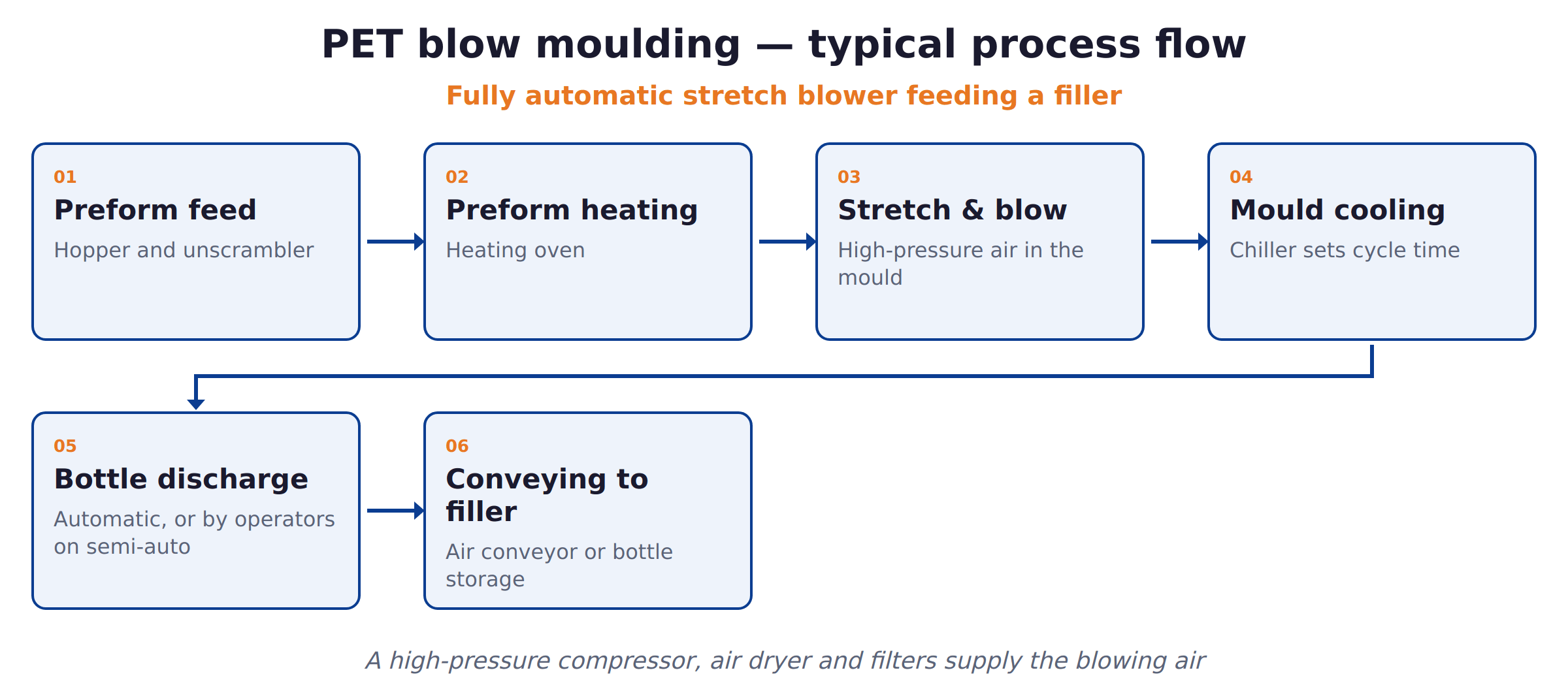
| Preform handling | Hopper, unscrambler, heating oven |
| Air system | Compressor, dryer, filters, receivers |
| Cooling | Chiller, mould temperature control |
| Conveying | Air conveyor or bottle storage to filler |
| Installation and training | Engineer days, trials |
| Owner's scope | Building, power, preforms or resin |
The prices only mean something once the scopes agree. The same-scope comparison shows how to align them.
Common mistakes
- Forgetting the compressor. It can cost as much as a small blower.
- One mould for a range of bottles.
- Blower faster than the filler. Bottles pile up.
- Buying preforms that do not suit the blower.
- No chiller. Cycle times rise and bottles deform.
Blow moulding machine prices in 2026
Indicative listed prices, in USD, from our blow moulding machine price guide:
| Purchase | Capacity | Indicative price (2026) |
|---|---|---|
| Semi-automatic PET blower | Two cavities, small bottles to 5–7 litre jars | About US$3,500–15,000 ex-works |
| Fully automatic PET blower | Two to six cavities | About US$20,000–95,000 ex-works |
| HDPE extrusion blow moulder | 1–20 litre containers | About US$13,000–50,000 ex-works |
| Preform injection machine | With a preform mould set | Machine about US$30,000–75,000, mould extra |
Packaging, food and duty in South Africa
- Food contact. Bottles for water, juice and oil are used in food premises under R638 of 2018, so bottlers expect clean, controlled production.
- EPR. Plastic packaging falls under the 2020 EPR scheme, so the brand owner funds collection and recycling through a producer responsibility organisation.
- Worker safety. Blowers, compressors and high-pressure air systems fall under the OHS Act, including pressure equipment rules.
- Duty. Blow moulding machines (8477.30) carry no general duty in SARS's 2026 tariff. VAT vendors reclaim the 15% import VAT; see the import duty guide.
Where CISH fits
CISH supplies, installs and commissions PET and HDPE blowers as part of complete filling lines from audited factories in China, with moulds, compressors, chillers and conveying matched to the filler, and your operators trained. We suit bottlers building or expanding a line. For a single semi-automatic blower, a local dealer is often the better choice.
Frequently asked questions
Who sells blow moulding machines in South Africa?
Dealers of imported blowers, used machine traders, Chinese factories selling direct, and turnkey companies that supply blowers with complete filling lines.
How much is a blow moulding machine?
Listed prices in 2026 run from about US$3,500–15,000 for a semi-automatic two-cavity PET blower and about US$20,000–95,000 for fully automatic PET blowers, before moulds and compressors.
What is the difference between PET and HDPE blow moulding?
PET blowers stretch and blow preforms into clear bottles; HDPE extrusion blowers extrude a parison and blow it into jerrycans and containers.
Do I need a special compressor?
PET blowers need high-pressure, dried compressed air, usually from a dedicated compressor. HDPE blowers need much lower pressure.
Is a blow moulding machine duty-free?
Blow moulding machines (8477.30) carry no general duty in SARS's 2026 tariff. Import VAT of 15% applies.
Does CISH sell single blowers?
We supply blowers as part of complete filling lines. For a single semi-automatic blower, a local dealer is usually the better route.