For thin liquids such as water and juice, gravity, overflow or flowmeter fillers are usual; carbonated drinks need pressure (isobaric) fillers. For thicker liquids, creams, sauces and pastes, piston or pump fillers measure by volume. For products sold by mass, such as oils in large containers, chemicals and some foods, net weight fillers are the most accurate. Powders are filled with auger fillers, and free-flowing granules such as sugar, rice and beans with cup (volumetric) or multihead weighers.
The quick guide
| Product | Examples | Usual filler type |
|---|---|---|
| Thin, still liquids | Water, juice, milk, vinegar, spirits | Gravity, overflow or flowmeter |
| Carbonated liquids | Soft drinks, beer, sparkling water | Pressure (isobaric) |
| Foaming liquids | Shampoo, dishwashing liquid, some detergents | Bottom-up overflow, or piston with nozzle diving |
| Medium viscosity | Cooking oil, syrup, liquid soap | Piston, pump or flowmeter |
| Thick liquids and pastes | Tomato sauce, mayonnaise, peanut butter, cream, lotion | Piston or rotary lobe pump |
| Products with pieces | Atchar, jam with fruit, salsa | Piston with large valve |
| Hot products | Hot-fill juice, sauces | Piston or gravity built for temperature |
| Sold by mass in large packs | 20 L oil, lubricants, chemicals | Net weight |
| Fine powders | Flour, milk powder, spices, cocoa | Auger |
| Free-flowing granules | Sugar, rice, beans, detergent powder | Volumetric cup or multihead weigher |
Liquid fillers
Gravity fillers
Product flows from a tank above the nozzles into the container under its own weight, for a set time or to a set level. Simple, cheap and easy to clean. Suits thin, still liquids. Accuracy depends on stable product level and temperature.
Overflow fillers
The nozzle seals on the bottle neck and fills until the liquid reaches a set height; excess returns to the tank. Every bottle looks filled to the same level, which matters in clear bottles even if the volume varies slightly with bottle shape. Suits water, juice, cleaning liquids and foaming products.
Pressure (isobaric) fillers
Used for carbonated drinks and beer. The bottle is pressurised to the same pressure as the tank before filling, so the gas stays in the drink. They are usually built into a rinse-fill-cap monoblock with tight control of temperature and pressure.
Piston fillers
A piston draws a measured volume from a hopper into a cylinder and pushes it out through a nozzle. Change the stroke and you change the volume. Piston fillers handle a wide range, from thin liquids to thick pastes and products with small pieces, which makes them the workhorse for sauces, creams, lotions and spreads.
Pump fillers
A gear, lobe or peristaltic pump meters product for a set time or number of turns. Lobe pumps are gentle and handle viscous products; peristaltic pumps keep product inside a tube, which suits small doses and products that must not touch metal.
Flowmeter fillers
A magnetic or mass flowmeter measures what passes each nozzle and closes the valve at the set volume or mass. Accurate, easy to change over, and clean in place, so they are common on modern water, juice, milk and edible oil lines. Magnetic flowmeters need conductive liquids, so they do not suit oils; mass flowmeters do.
Net weight fillers
Each container sits on a load cell and fills until it reaches the target mass. The most accurate method for products sold by weight and for large containers where small volume errors add up. Slower per nozzle than volumetric fillers.
Dry product fillers
Auger fillers
A rotating screw in a funnel doses powder by turns. Suits fine, non-free-flowing powders such as flour, milk powder, spices and protein powders. Usually paired with a check-weigher.
Volumetric cup fillers
Cups of adjustable size are filled from a hopper and emptied into the pack. Fast and cheap for free-flowing granules with consistent density: sugar, rice, salt, beans.
Multihead weighers
Many small weigh buckets combine to hit the target mass. Fast and accurate for snacks, frozen food, nuts and irregular products; usually above a form-fill-seal bagger.
How to choose, step by step
- Describe the product: thin or thick, still or carbonated, foaming, pieces, hot or cold, flammable or corrosive.
- Decide how you declare the contents: volume (ml, L) or mass (g, kg). Prepackaged goods must declare their quantity correctly under the Legal Metrology Act and SANS 289.
- List the containers: bottle, jar, tub, pouch, bag or drum, and every size.
- Set the speed: containers per minute now and in three years.
- Check hygiene: food, cosmetics and pharmaceuticals need sanitary design and cleaning in place; food lines sit in a food premises under R638.
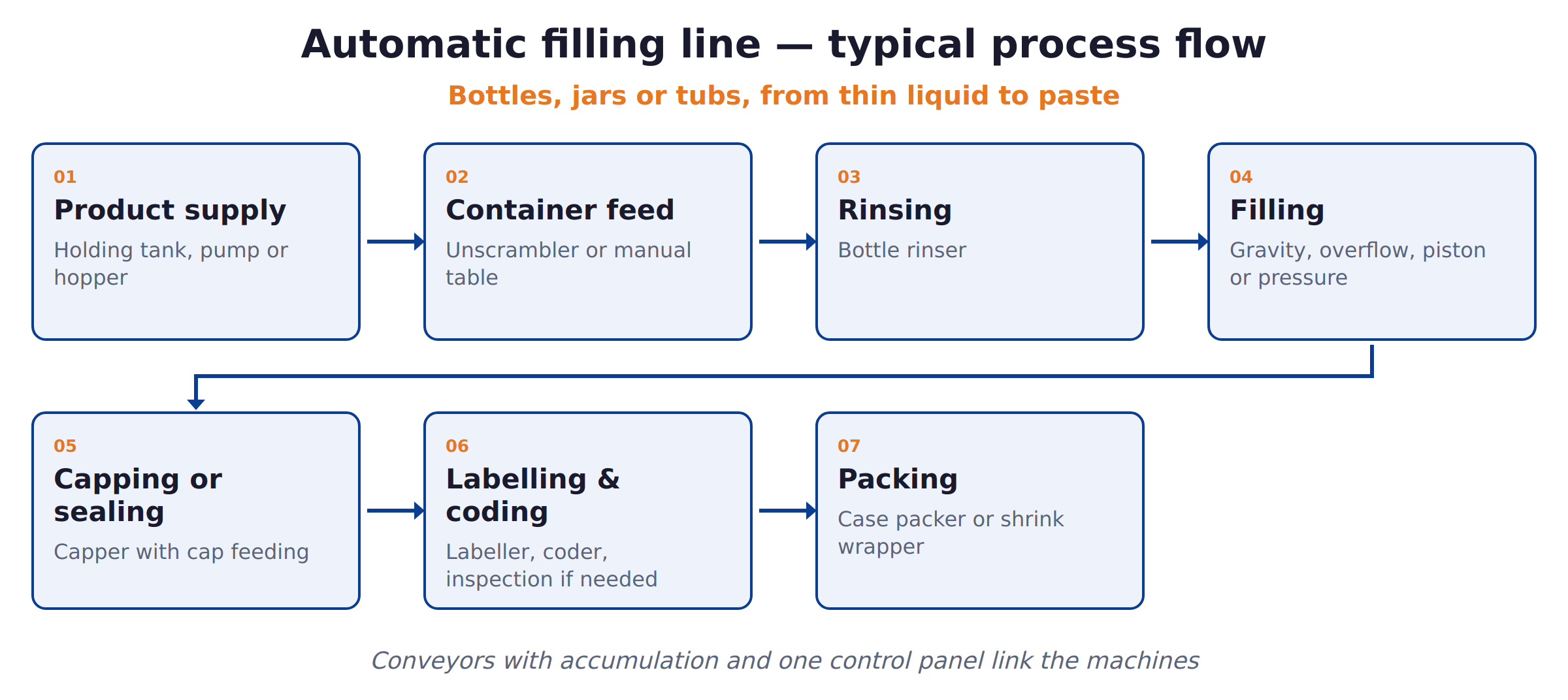
- Plan the rest of the line: capping, sealing, labelling, coding, check-weighing and packing must keep up.
- Ask for a trial on your product before you sign.
A worked example: one food maker, three products
Take a small food company that makes tomato sauce in 750 ml bottles, cooking oil in 2 L and 5 L bottles, and a spice mix in 100 g pouches. One filler cannot do all three well.
- Tomato sauce is thick and sometimes filled hot, so a piston filler with a heated hopper and a no-drip nozzle fits. A capper and a labeller follow it.
- Cooking oil is thin, does not conduct electricity and is sold by volume. A piston filler can do it at low volume; at higher volume a mass flowmeter or net weight filler gives better accuracy on the 5 L pack.
- The spice mix is a fine powder, so an auger filler with a check-weigher, feeding a pouch sealer, is the right match.
If the business can afford only one machine at first, the piston filler covers the sauce and the oil, with a change of nozzle and stroke, while the spices are packed by hand on a scale until volumes justify an auger. That is a typical path: buy for the product that sells most, and choose a filler type that can stretch to the next one.
Semi-automatic or automatic?
A semi-automatic filler, where an operator places and removes each container, suits start-ups and short runs; it typically fills a few to about 20 containers a minute depending on size and product. An automatic inline or rotary filler with conveyors suits steady volumes and is usually combined with a capper and labeller, or built as a monoblock. Moving from one to the other is mostly about labour and consistency, not only speed.
What filling machines cost
Indicative, in USD, from our filling machine price guide:
| Purchase | Indicative price (2026) |
|---|---|
| Semi-automatic filler, capper or labeller | About US$1,000–10,000 each |
| Automatic fill-cap-label monoblock | About US$13,000–60,000, by product and speed |
| Complete bottling line with water treatment and packing | From about US$150,000–400,000 |
Filling, closing and labelling machinery (8422.30) carries no general import duty.
Common mistakes
- Choosing by speed before product. A fast gravity filler cannot fill mayonnaise.
- One filler for every product. Sauces and water need different fillers.
- Ignoring foam. Detergents and shampoo overflow on the wrong filler.
- Volume fill for a product sold by mass. Temperature and density changes cause under-fill.
- No check-weigher. Under-filled packs break the pack declaration.
- Forgetting changeover. Many small runs need quick changeover more than speed.
Where CISH fits
We specify complete filling lines, filler, capper, labeller, coder, check-weigher and packing, from audited factories in China against your product and containers, and we trial on your product where the factory can. We ship and clear the line, install and commission it at the agreed speed and fill accuracy, and train your operators. For a single semi-automatic filler, a local dealer is often the better choice.
Chunky products in oil need the right filler; for the whole business, see how to start an atchar business.
Frequently asked questions
What are the main types of filling machines?
Gravity, overflow, pressure, piston, pump, flowmeter and net weight fillers for liquids; auger, volumetric cup and multihead weighers for dry products.
Which filling machine is best for thick products like sauce or cream?
A piston filler or a lobe pump filler. Both measure thick products accurately by volume.
Which filler should I use for water?
Gravity, overflow or flowmeter fillers, usually in a rinse-fill-cap monoblock for bottled water.
What filler is used for powders?
An auger filler for fine powders such as flour, milk powder and spices, usually with a check-weigher.
Which is the most accurate filling method?
Net weight filling is usually the most accurate, especially for large containers and products sold by mass.
How much does a filling machine cost?
As an indication for 2026, a semi-automatic filler costs about US$1,000–10,000 and an automatic monoblock about US$13,000–60,000.