Aseptic filling sterilises the juice and the packaging separately and fills them in a sterile zone, giving long shelf life in lightweight PET or cartons without preservatives; it is the most expensive and suits national brands and exports. As an indication for 2026, a filling monoblock of 1,000–4,000 bottles an hour costs about US$13,000–60,000, a complete hot-fill juice line for 2,000–4,000 bottles an hour about US$250,000–600,000, and lines above 10,000 bottles an hour about US$600,000–1.5 million or more; aseptic and NFC lines are priced per configuration. CISH supplies, installs and commissions complete juice lines.
The short answer
| Hot fill | Cold fill | Aseptic | |
|---|---|---|---|
| How it works | Pasteurise, fill hot, sterilise cap and bottle with the product's heat | Pasteurise or not, cool, fill cold | Sterilise product and packaging separately, fill in a sterile zone |
| Shelf life | Months at room temperature | Days to weeks chilled; longer with preservatives | Many months at room temperature |
| Bottles | Heat-set PET, glass | Standard PET, HDPE, glass | Lightweight PET, cartons, bags |
| Preservatives | Usually not needed | Often needed unless chilled | Not needed |
| Investment | Moderate | Lowest | Highest |
| Fits | Regional juice and nectar brands | Fresh juice, chilled distribution, high-acid drinks | National brands, exports, dairy-juice blends |
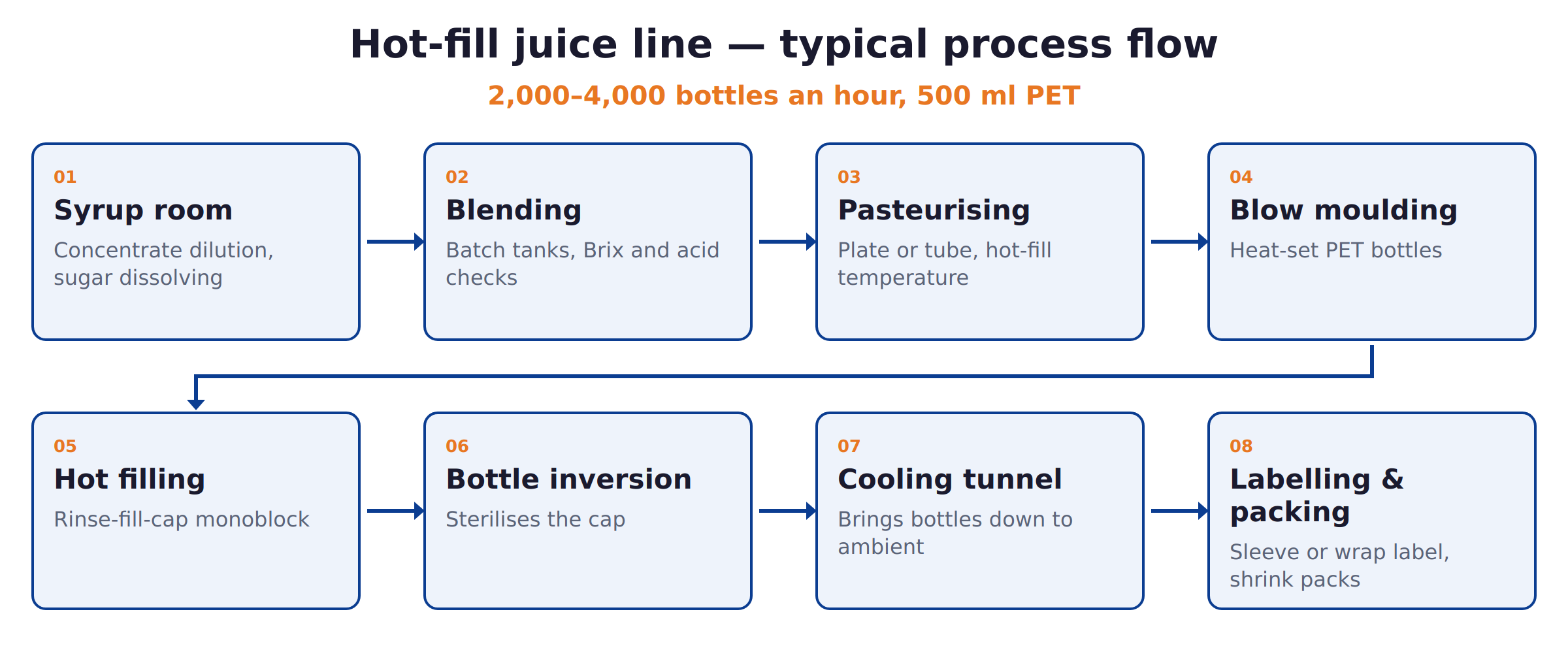
Hot fill: the regional workhorse
Hot filling is forgiving and proven. Juice is blended, pasteurised in a plate or tube heat exchanger, filled hot, capped, inverted or tilted so the hot juice sterilises the cap, then cooled in a tunnel. It needs heat-set PET bottles, which are heavier and cost more than ordinary bottles, or glass. Most regional juice and nectar brands use hot fill.
Cold fill: cheaper, with conditions
Cold filling uses standard bottles and simpler fillers. To be safe and last on the shelf, the product must be acidic enough, contain permitted preservatives, or be kept chilled. Fresh-squeezed and "not from concentrate" juices sold chilled are often cold-filled with short shelf lives, which means a cold chain from factory to fridge. Cold fill suits farm brands selling fresh juice close to home.
Aseptic: long life without heat in the bottle
Aseptic lines sterilise the product, often with UHT treatment, and sterilise bottles or carton material with hydrogen peroxide or other agents, then fill in a sterile chamber. Lightweight bottles and cartons cut packaging cost per litre, and shelf life is long without preservatives. The equipment, sterility validation and skills are the most demanding; aseptic suits national brands with long distribution chains and exports.
Product rules and the sugar levy
Fruit juices and drinks are classified and labelled under the regulations made in terms of the Agricultural Product Standards Act, which set names such as fruit juice, nectar and dairy fruit blend by juice content. Sugary drinks pay the Health Promotion Levy: 2.1 cents per gram of sugar above 4 grams per 100 ml, with a default value used if you cannot show a laboratory report. Your premises must meet R638. Our guide to starting a juice business covers registration.
Raw materials
Many South African juices are blends based on apple and orange, and concentrate is often imported, according to the USDA's citrus report. Fresh fruit juicing needs washing, extraction and finishing equipment and a fruit supply; reconstituting concentrate needs good water treatment and blending tanks. The filling method follows from the product: concentrate-based nectars usually go hot fill; fresh juices often cold fill.
Energy and utilities
Hot fill needs heat for pasteurisation and cooling for the tunnel; aseptic needs steam, sterilants and validated cleaning; cold fill needs chilling and cold storage. Ask each supplier for steam, power and water per thousand bottles. Fillers under 8422.30 enter duty-free, while heat exchangers under 8419.50 carry a 15% general duty, which affects landed cost.
Worked example: a citrus farm adds juice
A citrus farm in Limpopo wants to use fruit that does not meet export grade. Plan A cold-fills fresh orange juice for farm stalls and nearby shops, with a short chilled shelf life. Plan B hot-fills orange and mango nectar in heat-set PET for regional wholesalers. The farm starts with Plan A to test demand, and designs the building and utilities so a hot-fill pasteuriser and tunnel can be added within two years. The figures are illustrative.
Five questions before you buy
- What shelf life and distribution do you need?
- Will you sell chilled or at room temperature?
- Which bottles or cartons will you use, and are they heat-resistant?
- Fresh fruit or concentrate?
- What steam, power, water and cleaning does each line need?
Common mistakes
- Cold filling a low-acid drink without preservatives or a cold chain.
- Hot filling standard PET, which deforms.
- Aseptic ambitions without the skills to validate sterility.
- No sugar levy plan.
- A filler bought before the product is defined.
Choosing packaging with the process
The filling process and the pack go together. Hot fill needs heat-set PET bottles or glass that can take the heat without deforming; standard thin PET will collapse. Cold fill with preservatives or a short chilled shelf life can use standard PET, HDPE or cartons, but the cold chain must hold from the plant to the shop fridge. Aseptic filling usually means cartons or aseptic PET, with sterilised packaging and a sterile filling zone, and it is the largest investment of the three.
Think about your customers too. Spaza shops and schools want small, cheap packs that keep without a fridge, which suits hot fill or aseptic. Coffee shops and delis may accept chilled juice with a short shelf life. Supermarkets want consistent shelf life and barcodes. Match the process to the channel before you match it to the budget, and ask for shelf-life trials on your own recipe in the pack you will sell.
Trials before you commit
Run shelf-life trials with your own juice, in your own pack, at the temperatures your customers will store it. Check taste, colour, separation and microbial counts at intervals over the planned shelf life. A process that works for clear apple juice may not work for pulpy mango or a dairy-fruit blend. Many suppliers and food laboratories can run pilot trials before you buy a line, and the cost is small next to buying the wrong process.
Where CISH fits
We supply complete juice lines, fruit processing or blending, pasteurisation, hot, cold or aseptic filling, capping, labelling and packing, from audited factories in China, sized to your product and shelf life. CISH ships, clears, installs and commissions the line on your product, and trains your team. For a single small filler, a local supplier is usually the better buy.
Frequently asked questions
What is hot fill?
Juice is pasteurised and filled hot, typically around 85–95 °C, into heat-resistant bottles so the hot product sterilises the container and cap, giving months of shelf life.
Is cold fill safe for juice?
Yes, if the juice is acidic and preserved, or kept chilled with a short shelf life.
What is aseptic filling?
Product and packaging are sterilised separately and filled in a sterile zone, giving long shelf life without preservatives.
Which juice line is best for a small brand?
Usually hot fill for room-temperature nectars, or cold fill for fresh juice sold chilled nearby.
How much does a juice line cost?
As an indication for 2026, a complete hot-fill line for 2,000–4,000 bottles an hour costs about US$250,000–600,000; aseptic lines are quoted per configuration.
Does CISH supply juice lines?
Yes, hot, cold and aseptic lines with commissioning and training.