Any drink with added sugar above 4 g per 100 ml falls under SARS's Health Promotion Levy, juice must be named and labelled according to the fruit juice regulations, and the plant needs a Certificate of Acceptability under R638. A filling monoblock costs about US$13,000–60,000; a complete hot-fill juice line for 2,000–4,000 bottles an hour about US$250,000–600,000 ex-works. This page is about making juice, not running a juice bar.
Fresh juice or shelf-stable juice?
| Fresh or cold-pressed juice | Shelf-stable juice, nectar or juice drink | |
|---|---|---|
| Process | Wash, press, filter, bottle cold; sometimes high-pressure processing | Blend from fruit or concentrate, pasteurise, hot-fill or aseptic pack |
| Shelf life | Days to a few weeks, refrigerated | Months at room temperature |
| Customers | Delis, gyms, cafés, local stores, direct delivery | Supermarkets, wholesalers, spazas, schools, events |
| Equipment | Press, tanks, small filler, cold room | Mixing, pasteuriser, hot-fill or aseptic filler, capping, labelling, packing |
| Scale | Small, close to market | From thousands of bottles an hour |
| Main risk | Short shelf life and returns | Investment, price competition |
Step 1: Choose products and pack sizes
Decide what you will make: 100% juice, nectar or a juice drink, which flavours, and which packs. The fruit juice regulations under the Agricultural Product Standards Act define what may be called juice, nectar or a juice drink, by the share of fruit juice it contains, and what the label must show. Local juices are often blends; USDA's citrus report notes that many South African juices are apple and orange blends, and that much of the apple and pear concentrate used is imported from China.
Step 2: Secure fruit or concentrate
| Source | Pros | Cons |
|---|---|---|
| Fresh fruit | Fresh taste; local story | Seasonal; waste and peels to manage; pressing equipment needed |
| Concentrate | Year-round; consistent; smaller plant | Imported concentrate priced in dollars; less "fresh" positioning |
| Purées and pulps | For nectars and smoothies | Cold storage often needed |
Many shelf-stable producers work mostly from concentrate and add local fruit in season.
Step 3: Understand the sugar levy
The Health Promotion Levy applies to sugary beverages, charged per gram of sugar above 4 g per 100 ml. If you cannot show the sugar content with a test report from an accredited laboratory, SARS calculates the levy at 20 g per 100 ml. Manufacturers above the threshold in SARS's policy, 500 kg of sugar a year, must register with SARS Excise and submit returns. Check the current rate and rules on SARS's levy page before you set prices, and plan a lab test for every recipe. Sugar itself costs money too: white sugar averaged R67.81 per 2.5 kg at retail in July 2026, according to NAMC.
Step 4: Premises and approvals
A juice plant is a food premises. Under R638 of 2018 it needs hygienic construction, hand-wash stations, clean water, pest control, staff facilities and separation of raw fruit from the filling area. The municipality issues a Certificate of Acceptability after inspection. Also plan for:
- Waste water with sugar and fruit residues; ask the municipality about trade effluent.
- Fruit waste such as peels and pulp, which can go to compost or feed.
- Steam or hot water for pasteurising and cleaning.
Step 5: Choose the equipment
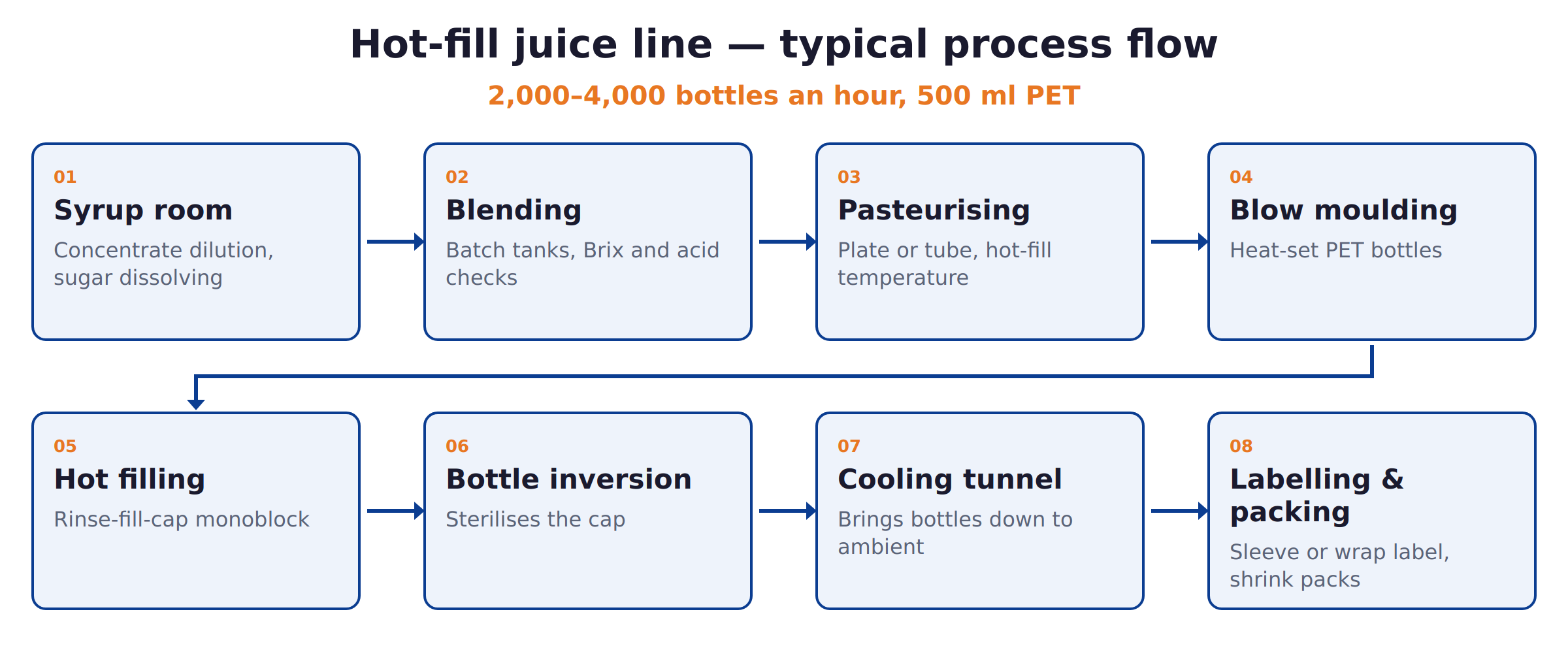
| Stage | Fresh juice plant | Shelf-stable juice line |
|---|---|---|
| Preparation | Washer, sorting table, press or extractor | Concentrate dissolving and blending tanks |
| Treatment | Filter, cold storage; optional high-pressure processing | Pasteuriser or UHT heater, homogeniser for nectars |
| Filling | Small filler and capper | Hot-fill or aseptic filler, capper |
| After filling | Labeller, cold room | Cooling tunnel, labeller, coder, shrink packer |
| Cleaning | Manual or simple CIP | Full CIP system |
Indicative, in USD, from our fruit juice line price guide:
| Purchase | Capacity | Indicative price (2026) |
|---|---|---|
| Filling monoblock only | 1,000–4,000 bottles/hour | About US$13,000–60,000 |
| Complete hot-fill juice or nectar line | 2,000–4,000 bottles/hour (500 ml) | About US$250,000–600,000 ex-works |
| Larger plant | 10,000 bottles/hour and up | About US$600,000–1.5 million or more |
| NFC, aseptic PET or carton | Any | Quoted per configuration |
Step 6: Plan the money
Beyond equipment you need a building, a boiler or heat source, a cold room for fresh juice or raw materials, bottles, caps, labels, sugar and concentrate stock, laboratory testing, and working capital for retailer payment terms. In most lines we see, equipment is about 35–55% of the project.
Step 7: Sell it
Fresh juice sells on taste and freshness, close to the customer. Shelf-stable juice sells on price, pack and distribution: spaza and wholesale channels move large volumes of affordable juice drinks, while supermarkets expect barcodes, supplier registration, food safety audits and promotional support. School and event contracts are another route. Start where you can supply reliably.
A realistic path
- Pilot a few recipes with lab-tested sugar content and correct labels.
- Small plant for fresh juice or a semi-automatic line, with a cold room.
- First retail listings and a distributor.
- Complete line for shelf-stable products once volumes are proven.
Worked example: from a juice kitchen to a hot-fill line
Picture a producer selling cold-pressed orange and mixed fruit juice in 350 ml bottles to cafés and gyms, a few hundred bottles a day. Shelf life of about a week limits the business to a small radius, and returns of unsold bottles eat the margin. To reach spaza shops and wholesalers, the owner develops a nectar and a juice drink from concentrate, tests their sugar content at an accredited laboratory, registers with SARS Excise because the levy applies, and labels each product with the name the regulations allow for its fruit content. The plant then needs blending tanks, a pasteuriser, a hot-fill monoblock for heat-resistant PET, a cooling tunnel, a labeller, a shrink packer, a CIP system and a boiler. The fresh range continues alongside on the original small equipment. The figures depend on volumes, but the order is typical: recipes and labels first, levy and approvals second, the line third.
Common mistakes
- Calling a product juice when it is a juice drink. The fruit content decides the name.
- No sugar test. SARS will levy on 20 g per 100 ml.
- Hot-filling into bottles not made for it. They deform.
- No CIP. Juice plants spoil quickly without proper cleaning.
- Underestimating fruit waste and effluent.
- Pricing without the levy.
Where CISH fits
We supply complete juice lines, from blending or pressing to packed cases, from audited factories in China, matched to your products and bottles an hour. CISH ships and clears the line, installs and commissions it with output demonstrated, and trains your team. For a press and a small filler for a fresh juice start-up, a local dealer is usually the better route.
Shelf life is decided by the filling method: our guide to hot fill, cold fill and aseptic juice filling explains the trade-offs.
Frequently asked questions
How much does it cost to start a juice business in South Africa?
As an indication for 2026, a filling monoblock costs about US$13,000–60,000, and a complete hot-fill line for 2,000–4,000 bottles an hour about US$250,000–600,000 ex-works.
Does fruit juice pay the sugar tax in South Africa?
The Health Promotion Levy applies per gram of sugar above 4 g per 100 ml. Check SARS's current rules for your product and test its sugar content at an accredited laboratory.
What licences do I need to make juice?
A Certificate of Acceptability for the food premises under R638, labels that meet the fruit juice regulations and food labelling rules, and registration with SARS Excise if the levy applies.
What is the difference between juice, nectar and a juice drink?
The share of fruit juice. The fruit juice regulations set the minimum juice content for each name.
Should I make fresh or shelf-stable juice?
Fresh juice suits a small plant close to its customers. Shelf-stable juice suits wider distribution but needs a complete heat-treatment and filling line.
Does CISH help with juice bars?
No. We supply production lines for juice manufacturers.