Juice production lines in South Africa are sold by local filling machine builders, dealers of European and Asian equipment, Chinese factories selling direct, and turnkey companies that supply the whole line from water treatment to packed cartons. Most local juice is blended from concentrate, so the syrup room, pasteuriser and hot-fill section matter more than the filler. Sugary drinks also pay the Health Promotion Levy, which shapes recipes.
Who sells juice production lines
Juice and nectar makers, dairies adding juice, farms with fruit and cooldrink brands all search for juice lines. The suppliers fall into four groups.
| Supplier type | What they sell | Price | Who answers for output | Best fit |
|---|---|---|---|---|
| Local filling machine builder | Fillers, cappers, labellers, some tanks | Higher per machine than imports | The builder, for its machines | Buyers adding or replacing a filler |
| Dealer of European or Asian equipment | Pasteurisers, fillers, blow moulders, packing | High for European; moderate for Asian | The dealer, per machine | Established plants upgrading a section |
| Chinese factory, direct | Complete juice lines, tanks, pasteurisers, hot-fill monoblocks | Lowest on the quote | You, after delivery | Buyers with their own process engineers |
| Turnkey juice line company | Water treatment to palletised cartons, laid out and commissioned | Between direct and European | The turnkey company, at agreed bottles per hour | New plants and first lines |
The filler is not the line
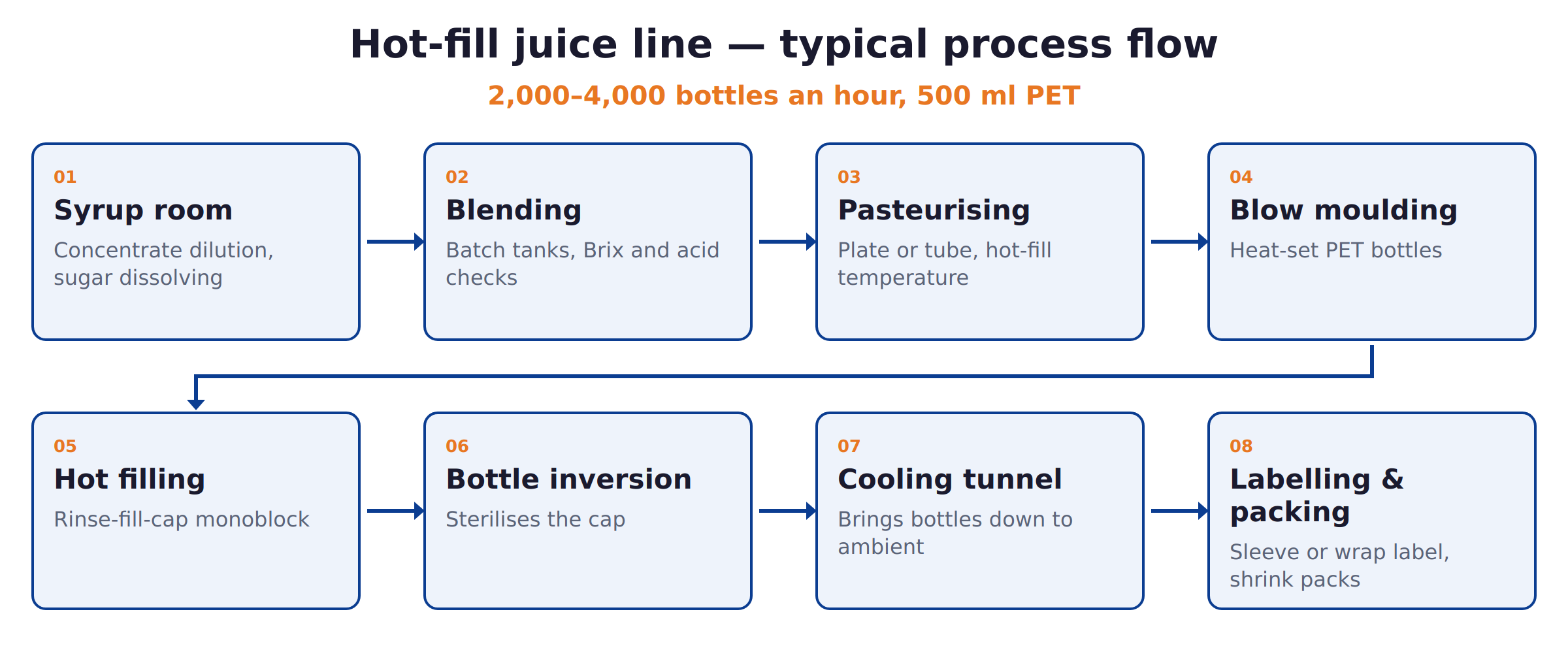
A juice line is mostly process: water treatment, sugar dissolving, blending tanks, a homogeniser or deaerator for some products, a pasteuriser, the hot-fill monoblock, a cooling tunnel, labelling, coding and packing. The filler is one machine in the middle. Many new juice makers buy a filler first and find they still need a syrup room, a pasteuriser and cleaning in place before they can sell a bottle.
Ask any supplier three things:
- Which product and pack, such as 100% juice from concentrate, nectar or a dairy blend, in PET, glass or carton.
- How the product is heat-treated and at what temperature and hold time.
- Bottles per hour at your pack size, measured over a full shift with cleaning time included.
What to check in the supplier
Process design
The supplier should size the blending tanks, pasteuriser and holding time for your recipe, and explain how the product is heated, held, filled hot and cooled. Hot-fill PET needs heat-set bottles and a cooling tunnel.
Hygiene and cleaning
Juice is a food, and sugar feeds yeasts and moulds. Ask about cleaning in place, the stainless grade of product-contact parts and how the filler is sanitised between products.
Spare parts and service
Filling valves, seals and pasteuriser plates wear. Ask what is supplied with the line and how quickly a technician can reach you.
Where to find juice line suppliers
- Beverage and food processing trade shows in Johannesburg and Cape Town feature filling and process equipment; confirm current dates with organisers.
- The Agricultural Product Standards juice regulations are the starting point for product classes and labels.
- Running plants: visit a line making a product and pack similar to yours.
- China: many complete juice lines sold in Africa are built in China. Run the supplier audit checklist before committing.
We leave juice line suppliers unnamed on this page.
How to choose: a 10-point checklist
- Product and pack defined: juice class, bottle or carton, sizes.
- Bottles per hour at your pack, demonstrated at handover.
- Water treatment sized to the line.
- Syrup room: sugar dissolving, blending, filtration.
- Pasteurising: temperature, hold time and recording.
- Hot-fill or aseptic route chosen for your shelf life.
- Cleaning in place included.
- Packing: labelling, coding, shrink or cartons, palletising.
- Utilities: steam, chilled water, compressed air, power.
- Commissioning, training and spare parts in the price.
Before choosing a supplier, settle the process: hot fill, cold fill or aseptic juice filling compared.
Ten questions to ask
- What bottles per hour does the line make at my pack size?
- How is my product pasteurised, and are temperatures recorded?
- Is the line hot-fill, cold-fill with preservatives, or aseptic?
- What water treatment is included?
- What tanks and blending equipment are included?
- Is cleaning in place included?
- What steam, chilled water and power does the line need?
- Is installation, commissioning and training included?
- What spare parts come with the line?
- Which plant in South Africa runs this line, and may I visit?
Comparing juice line quotes
| Section | What each quote should state |
|---|---|
| Water treatment | Filtration, softening or RO, UV, capacity |
| Syrup room | Sugar dissolver, blending tanks, filters |
| Heat treatment | Pasteuriser type, capacity, hold tube, recorder |
| Filling | Monoblock, valves, pack sizes, bottles per hour |
| Cooling and drying | Cooling tunnel, bottle dryer |
| Packing | Labeller, coder, shrink wrapper or case packer |
| CIP | Tanks, pumps, automation |
| Utilities | Boiler, chiller, compressor |
| Installation and training | Engineer days, operator training |
| Owner's scope | Building, drainage, power, water connection |
Before comparing totals, add what each quote is missing. The same-scope comparison shows the steps.
Common mistakes
- Buying a filler before the process. The line cannot sell without heat treatment and blending.
- No CIP. Yeast spoilage follows.
- Ignoring the sugar levy. Recipes above the threshold pay per gram.
- Wrong bottle for hot fill. Standard PET deforms.
- Comparing quotes on different scopes.
Juice line prices in 2026
Indicative, in USD, from our juice line price guide:
| Purchase | Capacity | Indicative price (2026) |
|---|---|---|
| Filling monoblock only | 1,000–4,000 bottles/hour | About US$13,000–60,000 ex-works |
| Complete hot-fill juice or nectar line | 2,000–4,000 bottles/hour | About US$250,000–600,000 ex-works |
| Mid-to-large plant | 10,000 bottles/hour and up | About US$600,000–1.5 million or more |
| NFC, aseptic PET or carton | Any | Quoted per configuration |
South African facts that shape the decision
- Sugar levy. The Health Promotion Levy has applied since 1 April 2018 at 2.1 cents per gram of sugar above 4 g per 100 ml, counting intrinsic and added sugar.
- Test reports matter. Without a SANAS or ILAC-accredited test report, SARS deems a drink to contain 20 g of sugar per 100 ml.
- Who registers. Commercial manufacturers using more than 500 kg of sugar a year must license with SARS Excise and file monthly.
- Juice classes. Fruit juice and drinks are classified, packed and marked under APS Act regulations (R286 of 1980, amended in 2013), which govern names like juice, nectar and drink.
- Concentrate supply. USDA reports that South African juice is typically an apple and orange blend, and that processors source apple and pear concentrate from China.
- Food premises. The plant must meet R638 of 2018 and hold a Certificate of Acceptability.
- Import duty. Filling machines (8422.30) and fruit juice machinery (8435.10, 8438.60) are free of general duty, while heat exchange units (8419.50) carry 15%. Import VAT of 15% applies and is reclaimable; see our import duty guide.
Where CISH fits
CISH is a turnkey juice line company. We specify complete lines from audited factories in China against your product and pack, from water treatment and syrup room to pasteuriser, hot-fill monoblock and packing, ship and clear them, and install and commission the line with bottles per hour demonstrated on your product, and your operators trained. We suit juice makers building a first line or a new plant. For a filler on its own, a local builder or dealer is often the better choice.
Frequently asked questions
Who sells juice production lines in South Africa?
Local filling machine builders, dealers of European and Asian equipment, Chinese factories selling direct, and turnkey companies that supply complete lines from water treatment to packing.
How much does a juice production line cost?
As an indication for 2026, a complete hot-fill juice or nectar line for 2,000–4,000 bottles an hour costs about US$250,000–600,000 ex-works. A filler on its own costs about US$13,000–60,000.
Does fruit juice pay the sugar tax?
The Health Promotion Levy counts intrinsic and added sugar above 4 g per 100 ml. Confirm the classification of your product with SARS before setting the recipe.
Hot fill or aseptic?
Hot fill suits PET and glass juices with a shelf life of months. Aseptic filling gives long shelf life without preservatives but costs much more.
Is juice machinery duty-free?
Filling machines and fruit juice machinery are free of general duty in SARS's 2026 tariff, but heat exchange units carry 15%. Import VAT of 15% applies.
Does CISH sell single fillers?
No. We supply complete juice lines, installed and commissioned. For a filler on its own, a local builder or dealer is usually the better route.