Poultry (broilers and layers), pigs, dairy and beef cattle, sheep and goats each need different formulas, and broiler feed is usually pelleted while many layer, dairy and ruminant feeds are sold as mash or pellets. As an indication for 2026, a complete small feed mill of 1–3 tonnes an hour with grinding, batching, mixing, pelleting and bagging costs about US$60,000–150,000 landed and commissioned; a medium mill of 3–10 tonnes an hour about US$250,000–900,000; industrial plants from about US$1.5 million. Raw materials, mainly maize, soybean meal and other oilcakes, make up most of the cost of feed, so buying and formulation decide the margin. Large feed companies dominate bulk supply, so new mills win on service, location and specialised feeds.
Step 1: choose your animals and products
| Animal | Typical products | Form |
|---|---|---|
| Broilers | Starter, grower, finisher | Crumbles and pellets |
| Layers | Pullet feed, layer mash or pellets | Mash or pellets |
| Pigs | Creep, weaner, grower, sow feeds | Pellets or mash |
| Dairy | Dairy meal, calf feeds | Pellets or meal |
| Beef, sheep, goats | Feedlot rations, licks, supplements | Mash, pellets, blocks |
| Fish | Floating or sinking feeds | Extruded pellets |
Start with one or two species you understand and whose farmers you can reach. Broiler and layer feeds sell in large volumes to small and medium farmers across the country.
Step 2: register your feeds under Act 36
Under Act 36 of 1947, farm feeds that are manufactured, imported or sold must be registered with the Registrar. Registration involves submitting the product details and laboratory analysis from an accredited laboratory, and registered feeds carry a registration number and a reference to Act 36 on the label, with the guaranteed analysis. Imported feeds need a permit as well as registration. A draft Feeds and Pet Food Bill was published in 2019 to replace the feed parts of Act 36; check its status. Our Act 36 guide explains the process.
Step 3: formulation and raw materials
Feed sells on animal performance. Work with an animal nutritionist to set formulas and review them when raw material prices change. Main ingredients:
- Energy: maize, maize by-products, wheat bran.
- Protein: soybean oilcake, sunflower oilcake, fish meal, canola.
- Minerals and vitamins: limestone, phosphates, salt, premixes.
- Additives: enzymes, coccidiostats where registered, toxin binders.
South Africa is a large maize and soybean producer: the Crop Estimates Committee's September 2026 forecast put soybeans at about 3.01 million tonnes. Prices still move with harvests, the rand and imports. Test raw materials for moisture, protein and mycotoxins, and store them dry.
Step 4: equipment and costs
| Mill | Output | Indicative price (2026) | Fits |
|---|---|---|---|
| Farm hammer mill and mixer | Farm scale | Priced locally | Farmers mixing their own feed |
| Complete small feed mill | 1–3 t/h | About US$60,000–150,000 landed and commissioned | New feed businesses |
| Medium feed mill | 3–10 t/h | About US$250,000–900,000 | Regional brands |
| Industrial feed plant | 10–30+ t/h | From about US$1.5 million | Large producers |
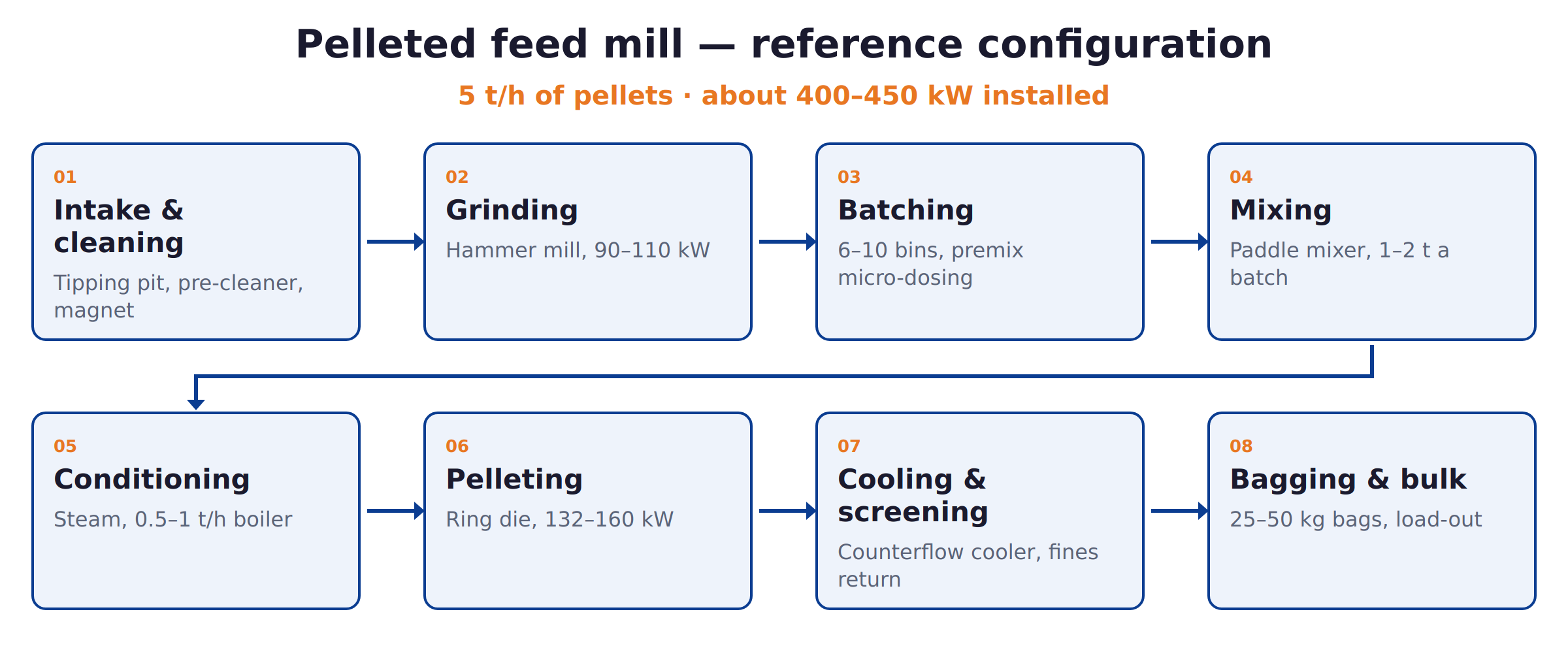
A complete mill includes intake, grinding, batching with scales, mixing, micro-dosing for premix, conditioning with steam, pelleting, cooling, crumbling and sifting for chick feed, and bagging. Our feed pellet machine price guide breaks the bands down. Feed machinery under heading 8436.10 enters duty-free.
Step 5: bagged or bulk
- Bagged feed in 25, 40 or 50 kg bags reaches small and medium farmers through co-operatives, agri-dealers and your own depot.
- Bulk feed in tankers suits large poultry, pig and feedlot customers and needs bulk bins and trucks, with lower margins per tonne.
Most new mills start with bagged feed and add bulk for a few large customers.
Step 6: power and steam
Hammer mills and pellet mills are heavy electricity users, and Eskom's standard tariff rose 8.76% for 2026/27. A pellet line also needs a boiler for steam conditioning. Plan the supply, backup, and efficient motors, and keep hammers and dies in good condition.
Step 7: quality and records
Keep a sample of every batch, record which raw material lots went into it, and test finished feed regularly for protein, moisture, fibre and minerals. Clean between medicated and non-medicated feeds. Farmers judge a feed by growth, egg production and milk yield, and they remember a bad batch.
Step 8: sell
Build relationships with farmers through co-operatives, agri-dealers, extension advisors and farm visits. Offer technical support: feeding programmes, a vet or nutritionist on call, and consistent delivery. The Animal Feed Manufacturers Association represents the formal feed industry and publishes industry information.
Worked example: a layer and broiler feed mill
A poultry farmer in Limpopo produces eggs and broilers and buys feed from a large supplier 300 km away. Neighbouring farmers ask to buy feed from him. He registers a broiler starter, grower and finisher and a layer mash under Act 36, and installs a 2 t/h mill with a hammer mill, batching scales, a ribbon mixer, a premix doser, a conditioner and pellet mill with a small boiler, a cooler, a crumbler and a bagging scale. A nutritionist sets the formulas. He sells bagged feed from his farm depot and delivers to farmers within 100 km. The figures are illustrative.
Common mistakes
- Selling unregistered feeds.
- No nutritionist: formulas that do not perform.
- Inaccurate batching.
- No raw material testing: mycotoxins and low protein.
- A pellet mill without conditioning.
- Too small a customer base for the mill.
Location and logistics
Feed is heavy and sells on price per tonne delivered, so location matters. A mill close to its farmers saves transport on finished feed; a mill close to its raw materials, such as maize from silos or oilcake from crushers, saves on inputs. Plan road access for trucks, a weighbridge or platform scale at larger mills, and covered storage for bagged feed. Many small mills deliver within a radius of 100–200 km and let farmers collect from the mill.
Pet food and fish feed
Pet food and floating fish feed need an extruder rather than a pellet mill, plus drying and coating, and pet food has its own registration under Act 36. They can be a second product line once the feed mill runs well.
Technical support sells feed
Farmers buy from suppliers who help them get results. Offer feeding guides, visit farms when growth or production falls, and keep records of the feed each customer bought. A farmer who trusts your advice is less likely to switch for a small price difference.
Where CISH fits
We supply complete feed mills, intake, grinding, batching, mixing, conditioning, pelleting, cooling and bagging, from audited factories in China, sized to your feeds and tonnes. CISH ships, clears, installs and commissions the mill on your formulas, and trains your team. Feed registration under Act 36 is applied for by the feed business. For a farm hammer mill, a local supplier is usually the better buy.
Choosing a pellet mill? Our comparison of ring die and flat die pellet mills shows which suits your tonnes.
Frequently asked questions
How much does it cost to start an animal feed business?
As an indication for 2026, a complete small feed mill of 1–3 tonnes an hour costs about US$60,000–150,000 landed and commissioned, before buildings, raw materials and working capital.
Do animal feeds need to be registered in South Africa?
Yes. Farm feeds manufactured, imported or sold must be registered under Act 36 of 1947.
Should I make mash or pellets?
Pellets for broilers and many pig feeds; mash or pellets for layers, dairy and ruminants, depending on your farmers.
What are the main raw materials for feed?
Maize, soybean and sunflower oilcake, wheat bran, limestone, phosphates, salt and premixes.
Is there import duty on feed mill machinery?
Feed machinery under heading 8436.10 enters duty-free; VAT applies.
Does CISH help with feed registration?
No. We supply the mill; the feed business registers its feeds under Act 36.