Label each product in the category R718 allows, such as natural water, water defined by origin or prepared water. Plan sales before the plant: water is a low-price, high-volume product won on distribution. CISH supplies, installs and commissions complete water bottling lines; for a refill station, a local water-treatment company is usually the better choice.
Step 1: Choose your business model
| Refill station | Bottling plant | |
|---|---|---|
| What you sell | Treated water into customers' containers | Sealed, labelled bottles and 5-litre or larger packs |
| Buyers | Households and offices nearby | Shops, spazas, forecourts, offices, events, wholesalers |
| Equipment | Treatment skid, filling taps, container washing | Treatment, bottle blowing or bought bottles, rinse-fill-cap, labelling, packing |
| Capital | Low | High |
| Rules | Food premises hygiene and water quality | Food premises, bottled water regulations, labelling, water use |
| Growth | Limited by walk-in customers | Limited by distribution and brand |
Many entrepreneurs start with a refill station to learn the market, then move to bottling when they have shop and office customers.
Step 2: Secure a water source
Your water is your product. Options:
- Municipal water, treated further, usually sold as prepared water.
- A borehole on your property or a leased site.
- A spring, if you can secure the rights and protect it.
Taking water from a borehole or surface source is a water use under the National Water Act. Depending on volume and area, you may need a licence, a general authorisation or registration with the Department of Water and Sanitation. Test the water at an accredited laboratory, repeat the test across seasons, and design treatment for what the results show.
Step 3: Decide the product category
R.718 of 2006 governs all bottled waters and sets out categories, each with its own requirements and labels:
| Category | What it means | Practical point |
|---|---|---|
| Natural water | Water from a protected underground source, bottled at the source, with limited treatment | Strict source and treatment rules |
| Water defined by origin | Water from a defined source, such as a borehole, with permitted treatment | Common for borehole brands |
| Prepared water | Water from any approved source, treated to be fit to drink | Common for municipal-water brands |
The category decides what you can print on the label, so settle it before you design labels or a brand, and check the exact definitions and treatment limits in R.718 itself.
Step 4: Set up compliant premises
The bottling hall is a food premises under R638 of 2018. It needs:
- Walls, floors and ceilings that can be cleaned, with proper drainage.
- Separate areas for raw materials, bottling and finished goods.
- Hand-washing, change rooms and a cleaning routine.
- Pest control and records.
- A Certificate of Acceptability from the local authority's environmental health practitioners.
Many retailers also expect bottlers to meet the SANBWA standard, which goes beyond basic hygiene. Ask your first buyers what they require.
Step 5: Choose the equipment
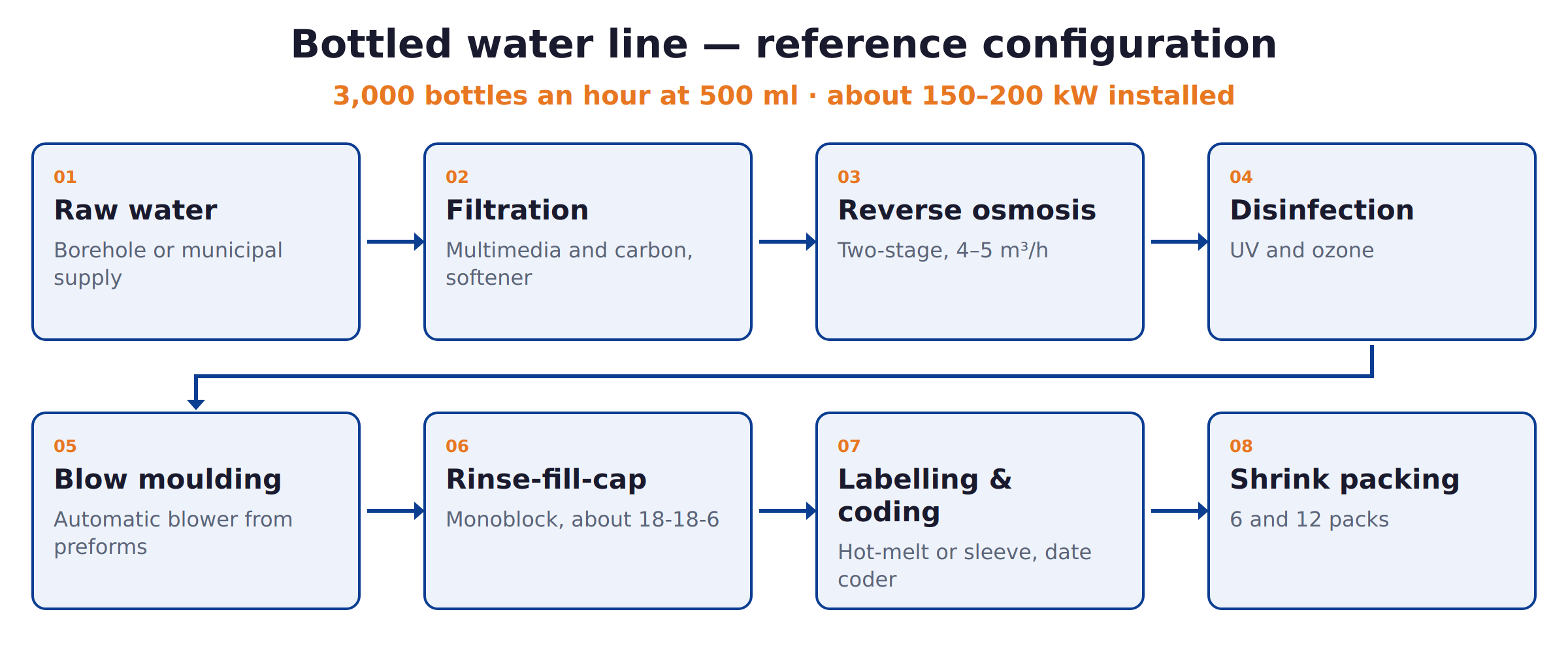
| Section | What it does |
|---|---|
| Water treatment | Filtration, often reverse osmosis, UV and ozone dosing |
| Bottles | Buy finished bottles, or blow your own from preforms |
| Rinse-fill-cap | Rinses, fills and caps bottles in one block |
| Labelling and coding | Labels and batch codes |
| Packing | Shrink wrapping or cartons, palletising |
| Laboratory | Routine microbiological and chemical testing |
| Line | Speed (600 ml basis) | Indicative equipment price (2026) |
|---|---|---|
| Entry line | 2,000–4,000 bottles/hour | About US$150,000–400,000 |
| Mid-speed plant | 6,000–12,000 bottles/hour | About US$400,000–900,000 |
| High-speed plant | 18,000+ bottles/hour | US$1 million and up |
Prices are for equipment; building, utilities, freight, installation and working capital come on top. See our water bottling plant cost guide.
Step 6: Plan the money
A bottling business needs cash for more than the line:
- Building and fit-out to food-premises standard.
- Water source work: borehole, testing, licensing.
- Bottles, preforms, caps, labels and film, bought in volume.
- Delivery vehicles or a distribution partner.
- Working capital for stock and customer credit.
- Registrations: company, tax and, once your turnover passes the threshold (R2.3 million a year from 1 April 2026), VAT.
Step 7: Win distribution
Water is cheap per bottle, so profit depends on volume and route efficiency. Before ordering a line, list:
- The shops, spazas, forecourts and offices that will stock your water.
- The price they will pay per bottle and per pack.
- How you will deliver, and how often.
- Whether you will make private-label water for others.
A realistic timeline
| Stage | What happens |
|---|---|
| Months 1–2 | Business model, source tests, water use check, buyer conversations |
| Months 2–4 | Premises, plant design, equipment quotes and order |
| Months 4–8 | Building works, equipment manufacture, shipping and clearance |
| Months 8–9 | Installation, commissioning, Certificate of Acceptability, labels |
| Month 9 onward | Launch with first buyers; add capacity as routes grow |
Timelines depend on your source, approvals and the equipment lead time.
Worked example: a borehole water start-up
An illustration only:
| Item | Assumption |
|---|---|
| Source | Borehole on a leased industrial site, registered with DWS |
| Category | Water defined by origin |
| Products | 500 ml, 1.5 litre and 5 litre |
| Line | Entry line at about 2,000–4,000 bottles an hour |
| Equipment | About US$150,000–400,000, plus building and utilities |
| Buyers | Local shops, forecourts and office deliveries |
From a delivered project: A 12,000 bottles-an-hour PET water line combined filling, blowing and labelling from China with locally fabricated steelwork and a local water-treatment specialist under one project lead; it landed at about US$850,000, six to eight weeks faster than a fully imported line, with more than 40% local content. Read the hybrid bottling line case study.
Common mistakes
- Buying the line before testing the water. Treatment must match the source.
- Ignoring water use rules. Borehole abstraction may need registration or a licence.
- Labels that do not match the R718 category.
- No distribution plan. The line sits idle.
- Underestimating packaging costs. Bottles, caps and labels are a large share of the cost per bottle.
- Skipping routine lab testing. One contamination incident can end a brand.
Rules in one place
- Bottled water: R.718 of 2006 sets categories, requirements and labelling.
- Food premises: R638 of 2018 and a Certificate of Acceptability.
- Water use: the National Water Act and DWS registration or licensing where required.
- Packaging: PET bottles fall under the 2020 EPR scheme for packaging, so brand owners join a producer responsibility organisation.
- Industry standard: the SANBWA standard is widely used by retailers as a benchmark.
Where CISH fits
CISH supplies, installs and commissions complete water bottling lines from audited factories in China, from treatment and bottle blowing to rinse-fill-cap, labelling and packing, with the line commissioned on your water and your operators trained. For a refill station, a local water-treatment company is usually the better choice, and we will say so.
Size the plant from what you can sell; our guide to choosing a water bottling plant works it through from bottles a day.
Frequently asked questions
How much does it cost to start a bottled water business in South Africa?
An entry bottling line for 2,000–4,000 bottles an hour costs about US$150,000–400,000 in equipment in 2026. Add the building, water source work, packaging stock, vehicles and working capital.
Do I need a licence to sell bottled water?
You need a Certificate of Acceptability for the premises under R638, labels that meet R718, and, if you take water from a borehole or surface source, registration or a licence where the National Water Act requires it.
Can I bottle municipal water?
Yes, as prepared water under R718, treated to be fit to drink and labelled accordingly.
Is a refill station a good way to start?
It needs far less capital and teaches you the market, but growth is limited to nearby customers. Many bottlers start there.
Should I blow my own bottles?
Buying finished bottles keeps capital down at the start. Blowing from preforms cuts bottle and transport costs once volumes grow.
Does CISH set up refill stations?
No. We supply complete bottling lines. For a refill station, a local water-treatment company is usually the better choice.