Repacking means buying refined oil in bulk and filling it into 750 ml, 2 L and 5 L bottles under your brand; it needs a clean premises and a filling line, from semi-automatic fillers at about US$1,000–10,000 to automatic monoblocks at about US$13,000–60,000. Pressing means buying sunflower or soybean seed, pressing it and selling crude oil to refiners and oilcake to feed mills; a single entry screw press costs under about US$10,000, and a 20 tonnes-a-day seed line about US$150,000–400,000 ex-works. Seed supply decides the business: the 2026 sunflower crop was estimated at about 875,000 tonnes and soybeans at about 3 million tonnes, with prices that change by season. A 750 ml bottle of sunflower oil averaged about R37.97 in July 2026, and cooking oil is zero-rated for VAT. CISH supplies, installs and commissions complete pressing, refining and filling lines.
Step 1: choose your stage
| Stage | What you buy | What you sell | Equipment | Indicative investment (2026) |
|---|---|---|---|---|
| Repacking | Refined oil in bulk | Bottled oil under your brand | Storage tanks, filler, capper, labeller | US$1,000–10,000 per semi-automatic machine; US$13,000–60,000 for a monoblock |
| Pressing | Sunflower or soybean seed | Crude oil to refiners; oilcake to feed mills | Seed cleaning, press, filter, storage | Under about US$10,000 for one press; US$150,000–400,000 for a 20 t/day line |
| Pressing and refining | Seed | Refined bottled oil and oilcake | Press line, refinery, filling | About US$400,000–900,000 for 50 t/day |
Refining is what turns crude oil into the clear, neutral oil shoppers buy. Without it, pressed sunflower oil sells mainly as crude oil or as speciality cold-pressed oil.
Step 2: seed supply
Sunflower is grown mainly in the Free State and North West, and soybeans across the summer rainfall areas. Grain SA's August 2026 report put the sunflower crop at about 874,805 tonnes, and the Crop Estimates Committee's September forecast put soybeans at about 3.01 million tonnes. Buy from farmers, co-operatives or traders, and store seed dry. Sunflower presses to roughly a third of the seed weight as oil, depending on the seed, so a 20 t/day line makes roughly 6–7 tonnes of crude oil a day.
Step 3: sell the oilcake
About two-thirds of the seed leaves the press as oilcake. Sunflower and soybean oilcake are protein ingredients for animal feed. Agree sales with feed mills or farmers before you start. If you sell oilcake as a farm feed product rather than as a raw material to registered feed mills, check whether it must be registered under Act 36 of 1947.
Step 4: licences and labels
- Food premises: pressing, refining and filling oil for sale is food handling; the premises must meet R638 and hold a Certificate of Acceptability from the municipality.
- Labels: R146 of 2010 requires the product name, ingredients, net volume, batch, dates and your details, with the rules for nutrition claims if you make them.
- VAT: cooking vegetable oil (other than olive oil) is zero-rated under the VAT Act.
- Retail: supermarkets will ask for a food safety audit and barcodes.
Step 5: equipment
- Repacking: bulk tanks with filters, a filling machine, capper, labeller, coder and carton sealing.
- Pressing: seed cleaner, dehuller for sunflower if you want higher-protein cake, screw presses, a filter press or leaf filter, crude oil tanks.
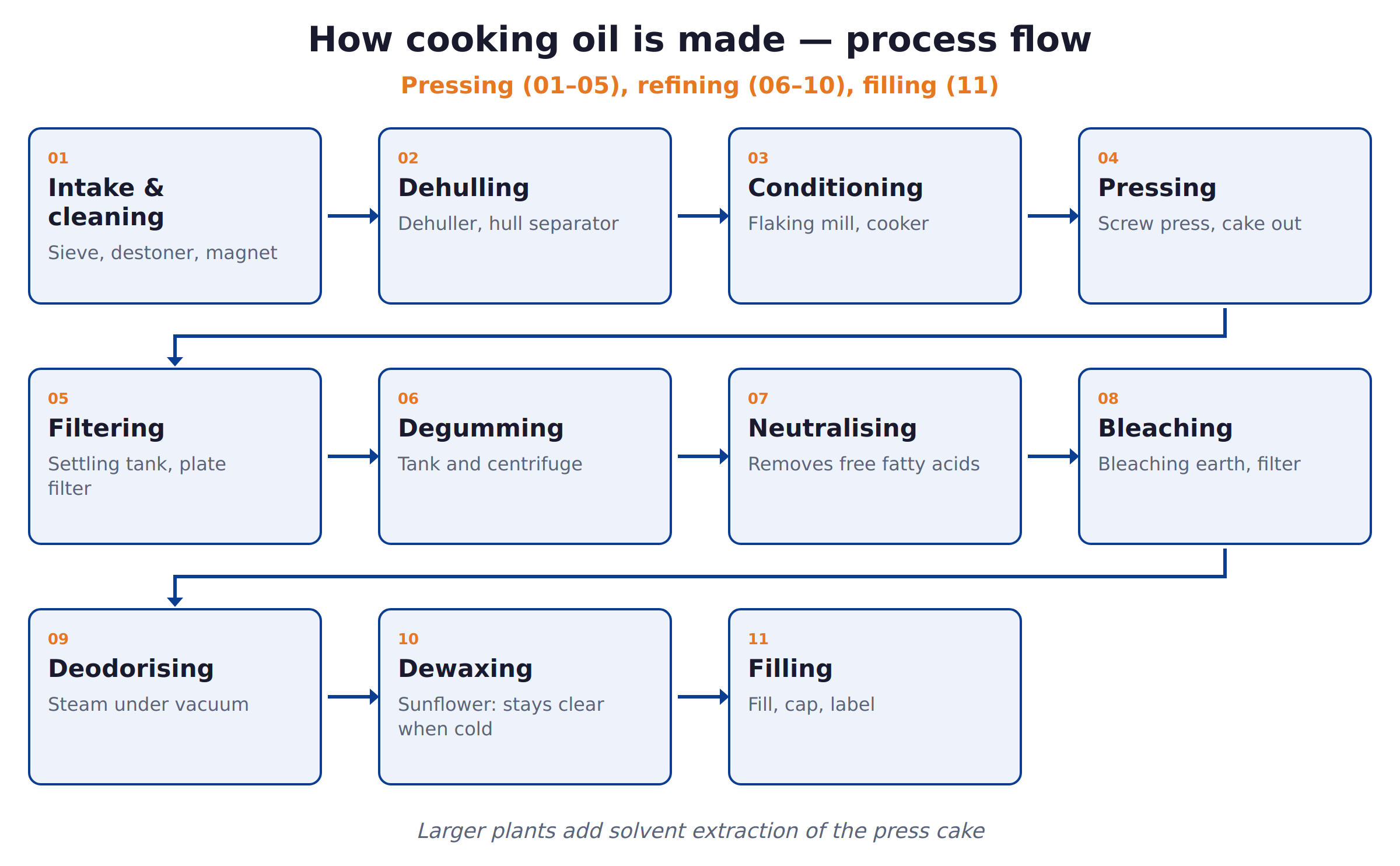
- Refining: degumming, neutralising, bleaching, deodorising and winterising for sunflower oil, with a boiler and vacuum system.
- Filling: a line from semi-automatic to automatic, matched to your bottle sizes.
Our cooking oil machine price guide sets out the bands, and how cooking oil is made explains each step.
Step 6: work out the numbers
For pressing, the margin is the value of crude oil plus oilcake minus the cost of seed, power, labour and transport. For refined bottled oil, add refining losses, chemicals, steam, bottles, caps, labels and cartons. For repacking, the margin is the difference between bulk refined oil and your bottled price, after packaging and distribution. Shelf prices are tight: a 750 ml bottle of sunflower oil averaged about R37.97 in July 2026 according to the NAMC, so cost control matters at every stage.
Step 7: sell
Spaza shops, wholesalers, informal traders, restaurants, takeaways and caterers buy 2 L, 5 L and 20 L packs. Supermarkets want 750 ml and 2 L bottles with consistent quality. Food manufacturers and fryers buy in bulk. Crude oil sells to refiners.
Worked example: a farmer group pressing sunflower
A group of sunflower farmers in North West sells seed to traders after harvest. It builds a 20 t/day pressing line with seed cleaning, two screw presses and a filter press, and stores seed in its own silos. Crude oil goes to a refiner on contract, and oilcake to two feed mills. After two seasons, with steady volumes, the group plans a small refinery and a filling line to sell its own bottled oil to local wholesalers. The figures are illustrative.
Common mistakes
- Pressing without a buyer for the oilcake.
- Expecting supermarket sales from unrefined oil.
- No seed storage or working capital.
- Filling in an unhygienic room.
- Labels without net volume or batch.
Quality control
Check crude and refined oil for free fatty acids, peroxide value and moisture, and refined oil for colour and clarity. High free fatty acids mean poor seed or storage; high peroxide value means oxidation and a shorter shelf life. Test each batch before filling, keep retained samples, and record the seed lot and refining conditions.
Storing oil and seed
Store seed dry and cool, and turn or aerate it to prevent heating. Store oil in clean, closed stainless or coated steel tanks, away from light and heat, and use first-in, first-out. Bottled oil keeps best in cartons out of direct sun. Good storage protects the margin that buying seed well created.
Staff and skills
A pressing line needs operators who can set presses for different seed and keep filters clean; a refinery needs a trained refiner and a laboratory technician. Train them during commissioning and keep written settings for each seed type, because press and refinery settings decide both oil yield and quality.
Where CISH fits
We supply complete pressing, refining and filling lines, from seed cleaning to bottled oil, from audited factories in China, sized to your seed and output. CISH ships, clears, installs and commissions the line on your seed, and trains your team. For a single screw press, a local supplier is usually the better buy.
Deciding how to press? See cold press vs hot press oil machines for yield, quality and buyers.
Frequently asked questions
How much does it cost to start a cooking oil business?
Repacking can start with semi-automatic fillers at about US$1,000–10,000 each. A 20 t/day pressing line costs about US$150,000–400,000 ex-works, and a 50 t/day line with refining about US$400,000–900,000.
Is it better to press or to repack oil?
Repacking needs less money and skill; pressing earns from both oil and oilcake but needs seed supply and buyers for crude oil or a refinery.
How much oil comes from sunflower seed?
Roughly a third of the seed weight when pressed, depending on the seed and the press.
Is VAT charged on cooking oil?
Cooking vegetable oil, other than olive oil, is zero-rated for VAT.
What do I do with the oilcake?
Sell it to feed mills or farmers as a protein ingredient; check Act 36 if you sell it as a registered farm feed.
Does CISH supply oil pressing and refining lines?
Yes, complete lines from seed cleaning to filling, with commissioning and training.