Cold pressing squeezes oil from seeds or fruit without heating them first, keeping temperatures low; hot pressing heats and conditions the seed before pressing, so more oil comes out. Cold-pressed oil keeps more of the seed's flavour, colour and natural compounds and is sold as a speciality product, but the yield is lower and more oil stays in the cake. Hot pressing gives more oil per tonne of seed and is the first step in commercial cooking oil plants, where the crude oil is then refined into clear, neutral oil for shops. Small cold presses for olives cost about US$1,000–7,000.
The short answer
| Cold press | Hot press | |
|---|---|---|
| Seed preparation | Cleaned, sometimes dehulled; not heated | Cleaned, cracked or flaked, then cooked or conditioned |
| Oil yield | Lower; more oil left in the cake | Higher |
| Oil flavour and colour | Natural flavour and colour retained | Stronger colour; usually refined afterwards |
| Refining | Often only filtered | Usually refined for retail cooking oil |
| Throughput per press | Lower | Higher |
| Market | Speciality oils, health stores, delis | Everyday cooking oil, food industry |
| Price per litre | High | Low |
Why heat changes the result
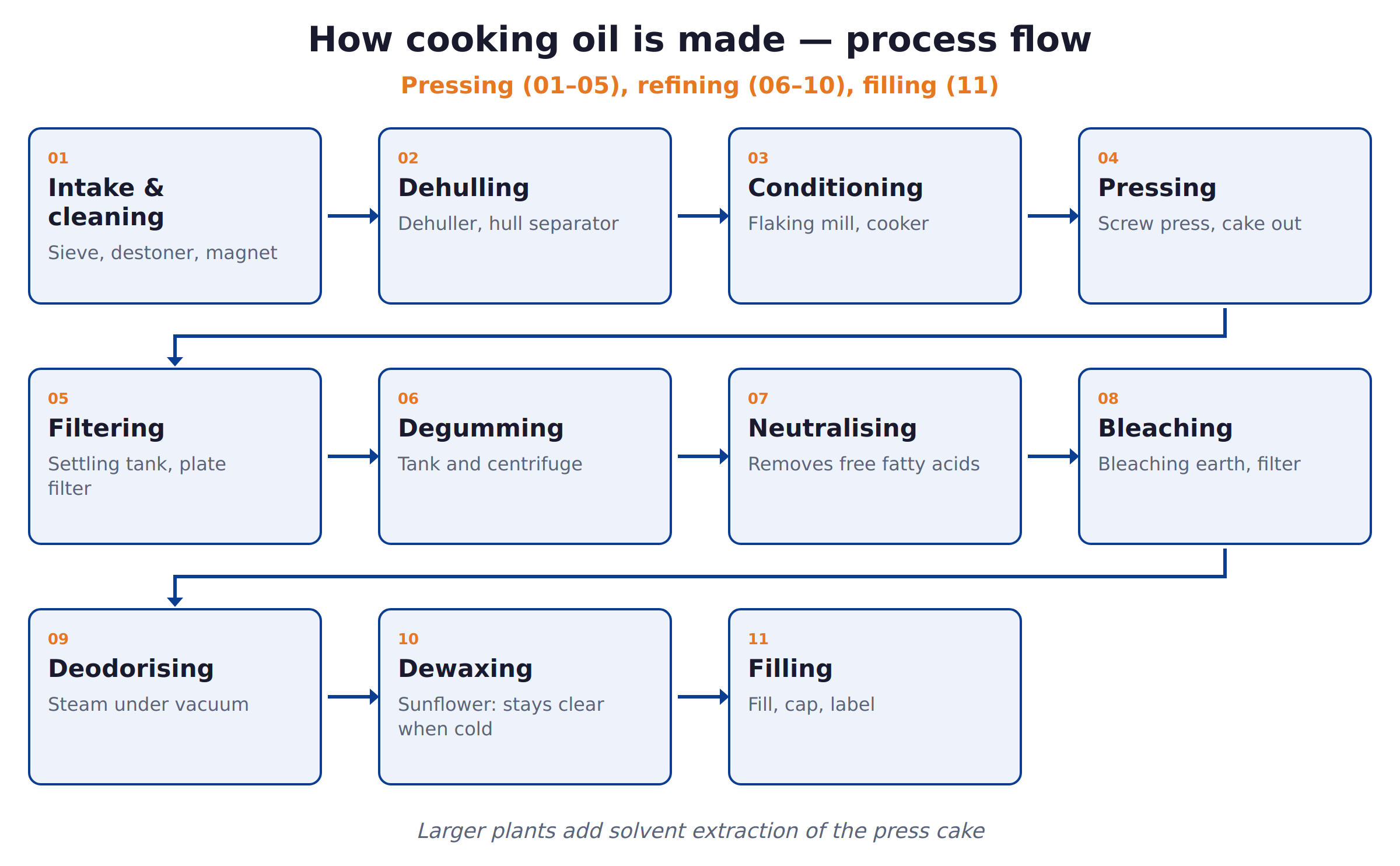
Heating and conditioning seed breaks down cell walls and makes the oil flow more easily, so the press extracts more of it and runs faster. It also darkens the oil and changes its flavour, which is why hot-pressed oil is usually refined: degummed, neutralised, bleached, deodorised and, for sunflower, winterised to remove waxes. Cold pressing keeps temperatures low by pressing unheated seed slowly; the oil is filtered and bottled with little further processing.
Which seeds suit which method
- Sunflower: both. Hot pressing and refining for everyday oil; cold pressing for a speciality product. Grain SA's August 2026 report put the South African sunflower crop at about 875,000 tonnes.
- Soybeans: low oil content; usually extruded or heated before pressing, or solvent-extracted in large plants. Cold-pressed soya oil is rare.
- Groundnuts and macadamia: both; cold-pressed nut oils are premium products.
- Olives and avocados: fruit oils made by crushing, malaxing and separating in a decanter, a cold process by design.
- Canola: both; cold-pressed canola is sold as a speciality oil.
The cake matters too
What leaves the press as cake is sold to feed mills and farmers. Cold pressing leaves more oil in the cake, which raises its energy value for animals but means less oil to sell. Hot pressing leaves leaner cake. Price the cake as part of your plan: in a commercial sunflower plant, it can be a large share of income.
Match the method to your business
Speciality oil brand
Cold pressing in small batches, bottled in glass or dark PET, sold to delis, health shops, restaurants and online. A small press, settling tank or filter, and a bottling table are enough to start; quality and branding sell the oil.
Commercial cooking oil
Hot pressing at 20 tonnes of seed a day or more, then a refinery and a filling line, to sell 750 ml, 2 litre and 5 litre bottles in volume. Cooking vegetable oil (other than olive oil) is zero-rated for VAT, and shelf prices are competitive, so yield and cost per litre decide profit. Our guide to how cooking oil is made explains each step.
Crude oil for refiners
Hot pressing without refining, selling crude oil in bulk to a refinery and cake to feed mills. Lower investment than a full plant; margins depend on seed and crude oil prices.
Labels and premises
Oil for sale is a food: your premises must meet R638 and hold a Certificate of Acceptability, and labels must meet R146. A "cold-pressed" claim on the label should be true to your process; keep records of press temperatures and methods.
Worked example: two routes for a sunflower farmer
A sunflower farmer in the Free State compares two plans. Plan A cold-presses about 1 tonne of seed a day into speciality oil for delis and online sales, with a small press, a settling tank and a bottling table. Plan B hot-presses 20 tonnes a day into crude oil for a refiner and cake for a feed mill. Plan A earns far more per litre but sells small volumes and needs marketing; Plan B uses more of the farm's crop and sells to two buyers. The farmer starts with Plan A and keeps selling seed until a crude oil contract is signed. The figures are illustrative.
Quality checks for both routes
Test oil for free fatty acids and peroxide value, check clarity and moisture, and keep retained samples. Cold-pressed oils are more sensitive to light and air; bottle them in dark containers and keep them cool. Refined oils are tested for colour, smell and stability before filling.
Five questions before you buy
- Will you sell speciality oil or everyday cooking oil?
- Which seeds will you press, and how many tonnes a day?
- Who will buy the cake?
- Will you refine, sell crude oil, or only filter?
- What oil yield and residual oil in cake does the supplier guarantee on your seed?
Common mistakes
- Expecting cold-press yields to match hot pressing.
- Selling hot-pressed, unrefined oil to supermarkets that expect refined oil.
- No buyer for the cake.
- Calling oil cold-pressed when the process heats the seed.
- Ignoring seed quality, which decides oil quality.
Filtering, settling and storage after pressing
Pressed oil contains fine solids and water. Small producers let it settle in tanks for days, then filter it through a plate or bag filter; larger plants use a filter press directly after the expeller. Cold-pressed oil is usually only filtered, so it keeps more colour and flavour but also more of the compounds that make it go stale faster. Store oil in clean, dark, closed containers away from heat and light, fill bottles to the top to limit air, and mark best-before dates realistically. Test free fatty acids and peroxide values on each batch if you sell to retailers, because those numbers show how fresh the oil is and how long it will keep.
Whatever press you choose, the seed is the biggest cost and the cake is your second product. Price both before you decide on a press type.
Where CISH fits
We supply complete oil plants, seed cleaning, preparation, pressing, filtering, refining and filling, and cold-press lines for speciality oils, from audited factories in China, sized to your seed and market. CISH ships, clears, installs and commissions the plant on your seed, and trains your team. For a single small press, a local supplier is usually the better buy.
For the business around the press, see how to start a cooking oil business in South Africa.
Frequently asked questions
What is the difference between cold press and hot press oil?
Cold pressing presses unheated seed for natural, flavourful oil at lower yield; hot pressing heats the seed first for higher yield, usually followed by refining.
Which gives more oil, cold or hot pressing?
Hot pressing typically gives more oil and leaves less in the cake.
Is cold-pressed oil better?
It keeps more flavour and natural compounds and sells at premium prices; refined hot-pressed oil is cheaper and suits everyday cooking.
Which method is used for olive and avocado oil?
A cold process: crushing, malaxing and separating in a decanter.
How much does an oil press cost?
As an indication for 2026, a single screw press with filter costs under about US$10,000; a 20 t/day pressing line about US$150,000–400,000 ex-works.
Does CISH supply oil pressing lines?
Yes, cold-press and hot-press lines, with refining and filling where needed.