Demand is strongly seasonal, peaking in summer and over the festive season, so a plant needs a cold store to build stock before the peak and a plan for the quiet months. Packaged ice is food: the premises needs a Certificate of Acceptability under R638, the water must meet SANS 241, and bags must be labelled. Power is the biggest running cost and outages melt stock, so supply and backup come first.
Which ice business?
| Bagged drinking ice | Block and flake ice | |
|---|---|---|
| Product | Cube or tube ice in 2–10 kg bags | Blocks of 5–50 kg, or flake ice in bulk |
| Customers | Liquor outlets, stores, filling stations, events, hotels, restaurants | Fishing, fish and produce traders, abattoirs, poultry, concrete and construction |
| Selling point | Clear, clean, hard ice; reliable supply in summer | Cooling power per rand; delivery in volume |
| Machines | Tube or cube ice machines, bagging, cold store | Block ice (brine or direct cooling) or flake ice machines |
| Seasonality | Very strong summer and holiday peak | Steadier, follows fishing seasons and harvests |
| Margin | Higher per kg; more packing and delivery work | Lower per kg; bigger volumes |
Many ice businesses start with one product and add the other once they have a cold store and delivery vehicles.
Step 1: Find your customers before your machine
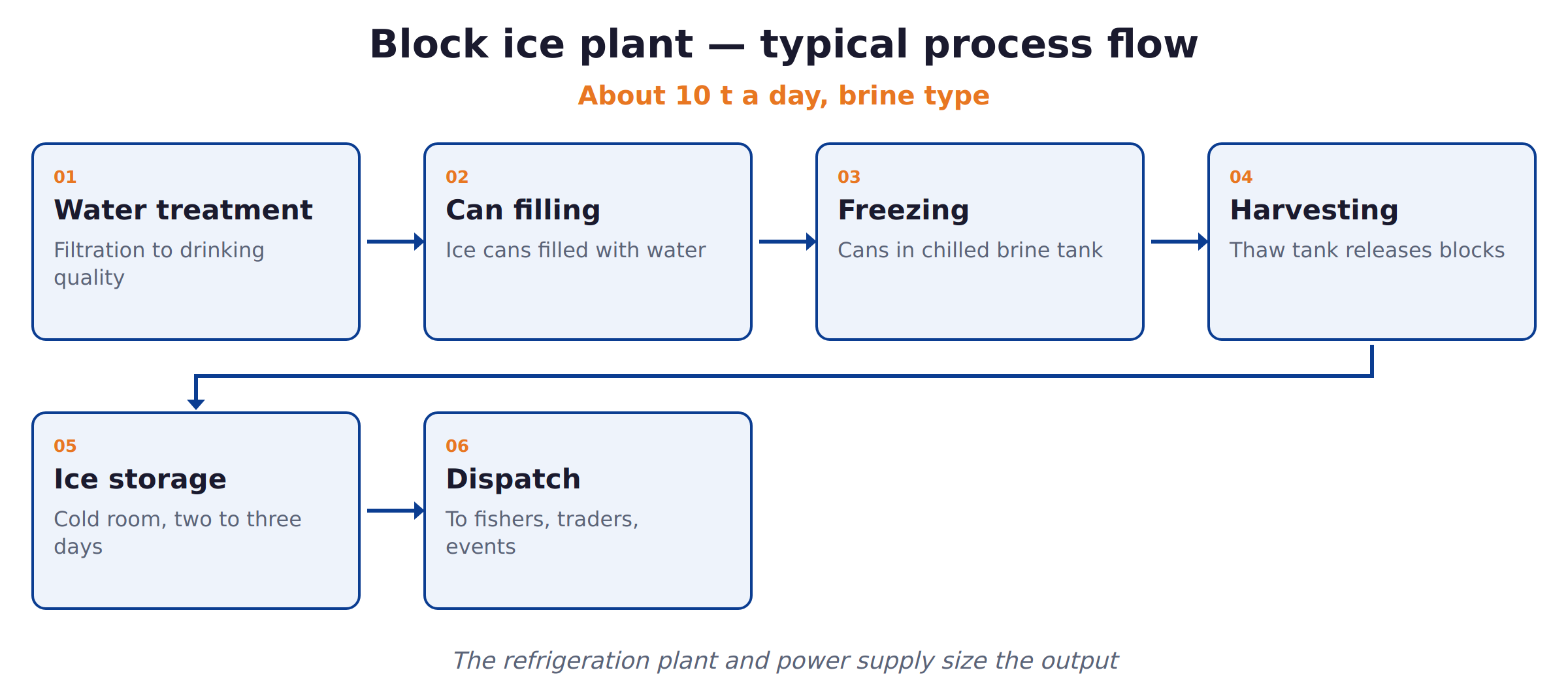
Ice is cheap to make but expensive to move and store. Most of your profit will come from customers within a short delivery radius. List the outlets, events, boats or traders you can reach, what they buy in summer and winter, and what they pay now. A few large accounts, such as a fishing harbour, a liquor distributor or a chain of filling stations, often decide whether the plant pays.
Step 2: Plan for the season
Sales may be several times higher in December than in June. You have three ways to cope:
- Build stock in a cold store in the weeks before the peak.
- Size the machines for a strong average day, not the peak, and use stock for the peak.
- Find winter customers, such as fishing, food processing or construction, to keep machines running.
The cold store is part of the plant, not an extra. A store sized for several days of peak sales is common.
Step 3: Sort out power first
Ice machines run on compressors that draw power around the clock. Running cost depends heavily on the machine type, the water temperature and the climate, so ask every supplier for kilowatt-hours per tonne of ice at your site conditions. Eskom's standard tariffs rose 8.76% for 2026/27. Outages melt stock and stop production, so plan:
- Supply capacity at the site, with the starting current of large compressors.
- Backup power for the cold store at least.
- Insulation and door discipline in the store to slow melting.
- Making ice at off-peak hours if your tariff allows.
Step 4: Water and food safety
Ice for drinks is food. The plant is a food premises under R638 of 2018 and needs a Certificate of Acceptability from the municipality. The water must meet the drinking water standard SANS 241; many plants add filtration, carbon and UV treatment even on municipal water, and boreholes need full treatment and testing. Hygiene rules apply to ice handling: clean scoops and bins, no bare-hand contact, clean bags and clean delivery vehicles. Bagged ice is a prepackaged food, so bags carry a label with the product name, net quantity, your details and the other information R146 requires.
Step 5: Choose the machines
| Machine | Ice | Typical use |
|---|---|---|
| Cube ice machine | Clear cubes | Drinks, hospitality |
| Tube ice machine | Hollow cylinders, cut to length | Bagged drinking ice, large volumes |
| Block ice machine (brine or direct cooling) | Solid blocks | Fishing, traders, long-distance cooling |
| Flake ice machine | Thin flakes | Fish and meat processing, concrete cooling |
| Bagging and sealing | Bagged ice | |
| Cold store | Stock before the peak |
Refrigerants matter. South Africa is phasing out ozone-depleting HCFCs under the Air Quality Act regulations, and new equipment using HCFC-22 may not be imported. Choose machines on refrigerants that will remain available and serviceable, and use refrigeration technicians registered as authorised persons.
Step 6: The numbers
Indicative, in USD, from our ice making machine price guide:
| Purchase | Capacity | Indicative price (2026) |
|---|---|---|
| Block ice machine (brine type) | About 10 t/day | About US$10,000–45,000 ex-works |
| Tube, cube or flake ice plant with bagging | 5–30 t/day | Quoted per configuration |
| Cold store for ice | Per size | From about US$15,000 installed for a small room |
| Complete ice plant with water treatment, packing and store | Per configuration | Quoted per configuration |
Ice machines (8418.69) carry no general import duty. On top of equipment you need the building or site, power connection, backup power, delivery vehicles, bags and working capital. In most plants we see, equipment is about 35–55% of the project.
Step 7: Delivery and sales
A refrigerated or insulated vehicle and a fixed delivery route are what keep customers. Liquor outlets and stores want reliable restocking on Fridays and before holidays; fishing customers want ice at the harbour before dawn. Branded bags and freezers placed at outlets help hold accounts. Agree payment terms in writing; many small accounts pay on delivery.
Worked example: a summer-led bagged ice plant
Assume a business aims to sell up to 10 tonnes of bagged tube ice a day in December and 2–3 tonnes a day in winter. It might install machines for about 5–6 tonnes a day, a cold store holding around 40–60 tonnes, bagging and two delivery vehicles, and build stock from October. In winter it runs one machine and sells block or flake ice to a fish trader to keep the plant busy. The figures are illustrative; your own plan depends on your customers and power cost.
Common mistakes
- Buying a machine without a cold store.
- Sizing for the December peak and running half-empty for nine months.
- Ignoring power capacity and backup.
- Skipping water treatment because municipal water looks clean.
- No labels on bags.
- Choosing old refrigerants that are being phased out.
Where CISH fits
CISH supplies complete ice plants, water treatment, ice machines, bagging and cold store, from audited factories in China, sized for your season and power. We ship and clear the plant, install and commission it with output demonstrated, and train your team. For a single small cube machine for a bar or shop, a local refrigeration dealer is usually the better choice.
The ice type follows the customer: see block ice vs tube ice vs flake ice before you choose a machine.
Frequently asked questions
Is an ice business profitable in South Africa?
It can be, if you have customers within a short delivery radius, a cold store to build stock for summer, and power costs under control. Winter sales often decide the result.
How much does it cost to start an ice business?
As an indication for 2026, a 10 tonne a day block ice machine costs about US$10,000–45,000 ex-works. Complete tube or cube ice plants with bagging and a cold store are quoted per configuration.
Do I need a licence to sell ice?
Packaged ice is food. The premises needs a Certificate of Acceptability under R638, the water must meet SANS 241, and bags must be labelled.
What is the difference between tube ice and cube ice?
Tube ice is formed as hollow cylinders and cut to length, suited to high-volume bagged ice. Cube ice is made in individual cubes, common in hospitality.
Who buys block ice?
Fishing boats, fish and produce traders, abattoirs and others that need long-lasting cooling.
Does CISH supply small ice machines?
We supply complete ice plants. For a single small machine, a local refrigeration dealer is usually better.