Avocado oil is made the same way from the fruit pulp. In South Africa, olive oil is not zero-rated for VAT, unlike other vegetable cooking oils, and imported extra virgin olive oil carries 10% general duty with exemptions for the EU and SADC. CISH supplies, installs and commissions complete olive and avocado oil lines.
Olive and avocado oil equipment prices in 2026
| Purchase | Capacity | What is included | Indicative price (2026) |
|---|---|---|---|
| Small cold press (hydraulic or screw) | About 20–75 kg/h | One press; filtering separate | About US$1,000–7,000 |
| Decanter centrifuge only | From about 1 t/h | Three-phase or two-phase decanter | About US$10,000–50,000 ex-works |
| Complete olive or avocado oil line | About 0.5–2 t/h of fruit | Hopper, leaf remover, washer, crusher, malaxer, decanter, vertical separator, pumps, controls | About US$30,000–200,000 ex-works |
| Larger mills, storage and bottling | Above 2 t/h | Multiple malaxers, stainless storage under inert gas, bottling | Quoted per configuration |
Factory listing prices, not quotes. Freight, installation, a building, water, power, storage tanks, a laboratory and working capital come on top; in most lines we see, equipment is about 35–55% of the project.
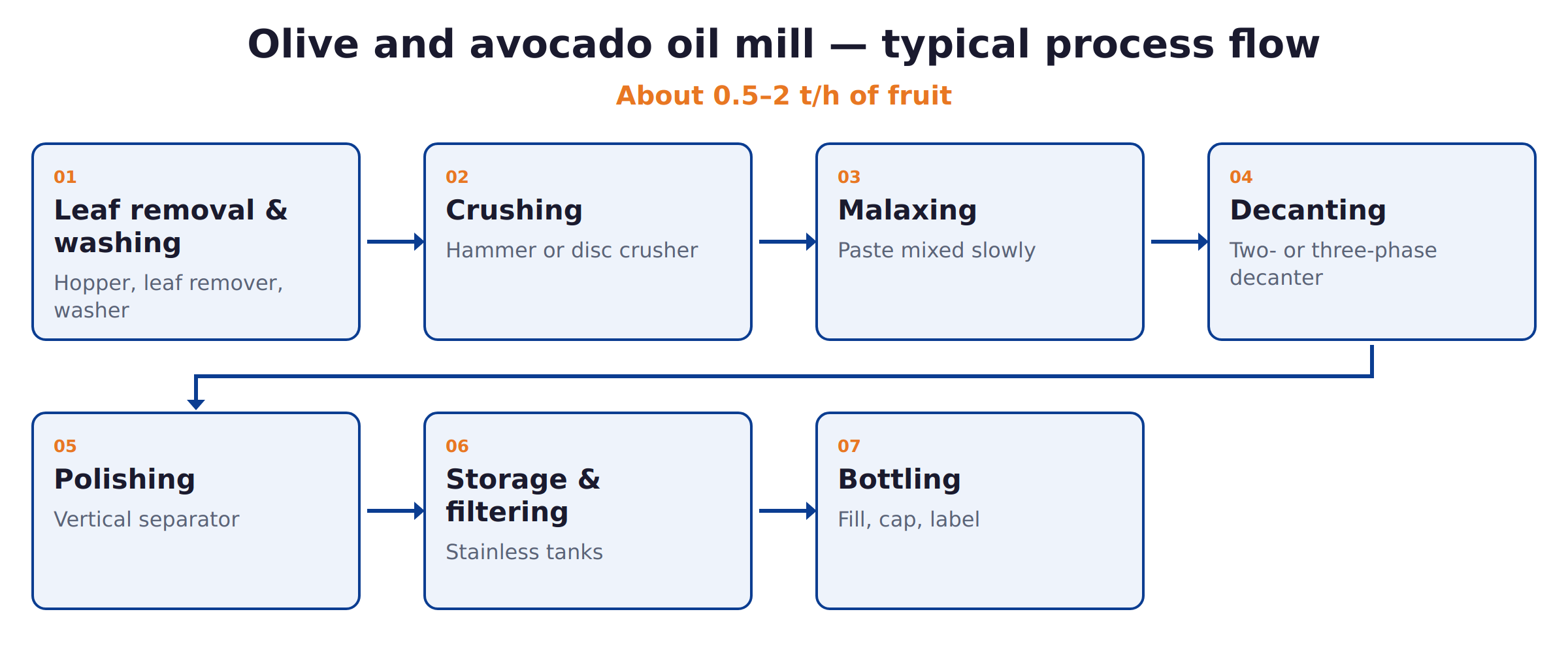
How an olive mill works
- Receiving and leaf removal. Fruit is weighed, leaves and twigs blown off.
- Washing. Soil and stones removed.
- Crushing. A hammer or disc crusher turns fruit, including the pit, into paste.
- Malaxing. The paste is stirred slowly in a heated, often covered tank for a set time so small oil droplets join together. Temperature is kept low for "cold extraction" quality.
- Decanting. A horizontal decanter centrifuge separates oil from water and solids. Three-phase decanters add water and produce oil, vegetable water and pomace; two-phase decanters produce oil and a wet pomace and use less water.
- Separating. A vertical disc separator removes the last water and fine solids.
- Storage and bottling. Oil is settled or filtered, stored in stainless tanks away from light and air, and bottled.
Avocado oil follows the same path after the fruit is pitted and pulped, which is why many lines are offered for both fruits.
Why a press is not a mill
Small hydraulic and screw presses are sold for olives and avocados and suit trials, boutique volumes and hobby growers. A mill for a commercial grove or a group of growers needs crushing, malaxing and a decanter, because:
- Harvest volumes are large and fruit must be milled within hours or a day or two of picking to keep quality.
- Decanters recover more oil and give a cleaner product at volume.
- Quality grades depend on process control, especially temperature and time.
Yield and what decides it
Olive oil yield is commonly in the region of 10–20% of fruit mass, and it varies with cultivar, ripeness, water content and the mill. Avocado oil yield depends heavily on the fruit's oil content and on whether the fruit is export-reject or processing grade. Ask suppliers for yield guarantees only after a test on your fruit.
The South African industry
SA Olive represents the olive industry, from nurseries and growers to olive oil and table olive producers, packers and importers, and runs a seal for locally produced extra virgin olive oils of participating members. The South African Avocado Growers' Association represents avocado growers and lists processors. Olive groves are concentrated in the Western Cape's winter rainfall areas, while avocados are grown mainly in Limpopo, Mpumalanga and KwaZulu-Natal, where fruit not suitable for export or fresh markets is a raw material for oil.
Choosing by scenario
- Single grove starting to mill its own fruit: a complete line of about 0.5–1 t/h with a two-phase decanter, sized for the harvest.
- Several growers sharing a mill: a larger line with more malaxer capacity and storage, and good records of each grower's batches.
- Avocado packhouse adding oil: a pulping step in front of the decanter line, and cold storage for fruit waiting to be processed.
- Boutique producer: a small press and filter may be enough for limited volumes.
Landed cost: what else to budget
| Item | Notes |
|---|---|
| Building | Hygienic floor and drains; space for fruit bins |
| Water | Washing and, for three-phase decanters, process water |
| By-products | Pomace and vegetable water must be handled; pomace can be composted or dried |
| Storage | Stainless tanks, ideally with inert gas |
| Laboratory | Acidity and peroxide tests for grading |
| Bottling | Dark glass or tins; filler and capper |
| Power | Decanters and malaxers need a three-phase supply |
Machinery for extracting fixed vegetable oils (8479.20) and centrifuges (8421.19) carry no general import duty.
How to compare quotes
- Fruit per hour the line processes, and the decanter rating.
- Two-phase or three-phase decanter, and the water use.
- Malaxer volume, heating and covers.
- Separator included.
- Stainless steel grade for oil-contact parts.
- Controls for temperature and time.
- Installation, commissioning on your fruit, and training.
- Spares for decanter wear parts.
- References of mills running similar volumes.
- Delivery in time for harvest.
Rules and tax in South Africa
- Food premises. A mill is a food premises under R638 and needs a Certificate of Acceptability.
- Labelling. Bottled oil must be labelled under R146; grade claims such as "extra virgin" should be backed by tests.
- VAT. Olive oil is excluded from the VAT zero rating that applies to other vegetable cooking oils.
- Import duty. Extra virgin olive oil (1509.20.90) carries 10% general duty, with exemptions for the EU and UK and for SADC.
Worked example: a grove that wants its own mill
Picture a Western Cape grower whose olives have been milled by a neighbour for a fee. Picking has to wait for a slot at the other mill, and fruit sometimes sits for days, which lowers oil quality. The grower considers a small press, but the harvest is many tonnes over a few weeks, so a press would be far too slow.
A line of about 0.5–1 tonne of fruit an hour fits better: a hopper and leaf blower, a washer, a hammer crusher, two malaxers so one can fill while the other mixes, a two-phase decanter to save water, a vertical separator and stainless storage tanks under nitrogen. The grower plans a concrete pad for fruit bins, a three-phase power supply, and a composting area for pomace. In the first season the mill runs the grower's own fruit; in later seasons it mills for neighbours, which helps pay for the line. Lab tests of acidity and peroxide value on every batch let the grower label oil correctly and sell the best lots as extra virgin.
Common mistakes
- Buying a press for a commercial harvest.
- Undersized malaxers. Fruit waits and quality drops.
- No plan for pomace and vegetable water.
- Storing oil in light or warm conditions.
- Claiming extra virgin without tests.
Where CISH fits
We supply complete olive and avocado oil lines, from fruit reception and washing to decanting, separating, storage and bottling, from audited factories in China, sized to your harvest. CISH ships and clears the line, installs and commissions it on your fruit, and trains your team. For a small press for trials, a local dealer or direct purchase is usually enough.
Frequently asked questions
How much does an olive oil press machine cost in South Africa?
As an indication for 2026, a small cold press costs about US$1,000–7,000, a decanter centrifuge about US$10,000–50,000, and a complete line for about 0.5–2 tonnes of fruit an hour about US$30,000–200,000 ex-works.
Is olive oil pressed or centrifuged?
Modern mills crush and malax the fruit and separate the oil in a decanter centrifuge. Small presses are used for trials and boutique volumes.
Can the same line make avocado oil?
Usually yes, with a pitting and pulping step in front of the decanter.
How much oil do olives give?
Commonly in the region of 10–20% of fruit mass, depending on cultivar, ripeness and the mill.
Is olive oil zero-rated for VAT in South Africa?
No. Vegetable cooking oils are zero-rated, but olive oil is excluded.
Does CISH supply small olive presses?
We supply complete olive and avocado oil lines. For a small press, a direct purchase or local dealer is usually enough.