Municipal, mall and estate work usually asks for pavers that meet SANS 1058, which covers strength, abrasion and dimensions, so dense mixes, colour control and proper curing matter more for pavers than for blocks. CISH supplies, installs and commissions complete paver and block plants.
Paver line prices in 2026
| Scale | What is included | Indicative price (2026) |
|---|---|---|
| Manual or egg-laying machine with paver moulds | Machine, moulds, small mixer; pavers laid on a slab | About US$8,000–40,000 per machine; complete small yard under about US$80,000 |
| Semi-automatic pallet plant | Stationary vibro-press, pallets, weigh-batching, pan mixer, conveyors, curing area | About US$120,000–450,000 landed and commissioned |
| Fully automatic plant | Automatic batching with colour dosing, high-output press, face-mix unit, stacker, curing chambers, cuber | About US$600,000–1.5 million or more, civils extra |
The ranges are the same as for block plants, because the machines are the same; output, moulds, the face-mix unit and curing make the difference. Brick and paver machines (8474.80) carry no general import duty.
Pavers versus blocks: what changes on the line
| Factor | Blocks | Pavers |
|---|---|---|
| Density and strength | Moderate | High; dense mix, strong compaction |
| Surface | Rough or plain | Smooth, coloured face; often a face-mix layer |
| Colour | Rare | Common; needs pigment dosing |
| Moulds | Hollow or solid block | Rectangular, interlocking, cobble and other shapes |
| Curing | Important | Critical for strength and abrasion |
| Standard | SANS 1215 | SANS 1058 |
Interlocking or rectangular pavers?
- Rectangular pavers are simple, stack well and suit driveways, sidewalks and patterns such as herringbone.
- Interlocking pavers, such as zigzag or "I" shapes, lock together sideways, which helps under traffic and on roads and parking areas.
- Cobbles and decorative shapes sell at higher prices to homeowners and landscapers, but each needs its own mould.
Start with one or two shapes your market buys most, and add moulds later.
Hydraulic or vibration?
Most paver machines combine vibration with pressure: a vibrating table compacts the mix while a pressing head pushes down. Fully hydraulic presses apply very high pressure and can make dense units with less vibration, while vibro-presses are the common choice for pallet plants. The decisive factors are the compaction you achieve, cycle time, and how evenly the moulds fill. Ask for sample pavers made on the machine with your aggregates, tested for strength.
Pallets, curing and stacking
- Pallets. Stationary machines produce pavers on production pallets of steel, wood, plastic or composite. You need enough pallets for every board in curing.
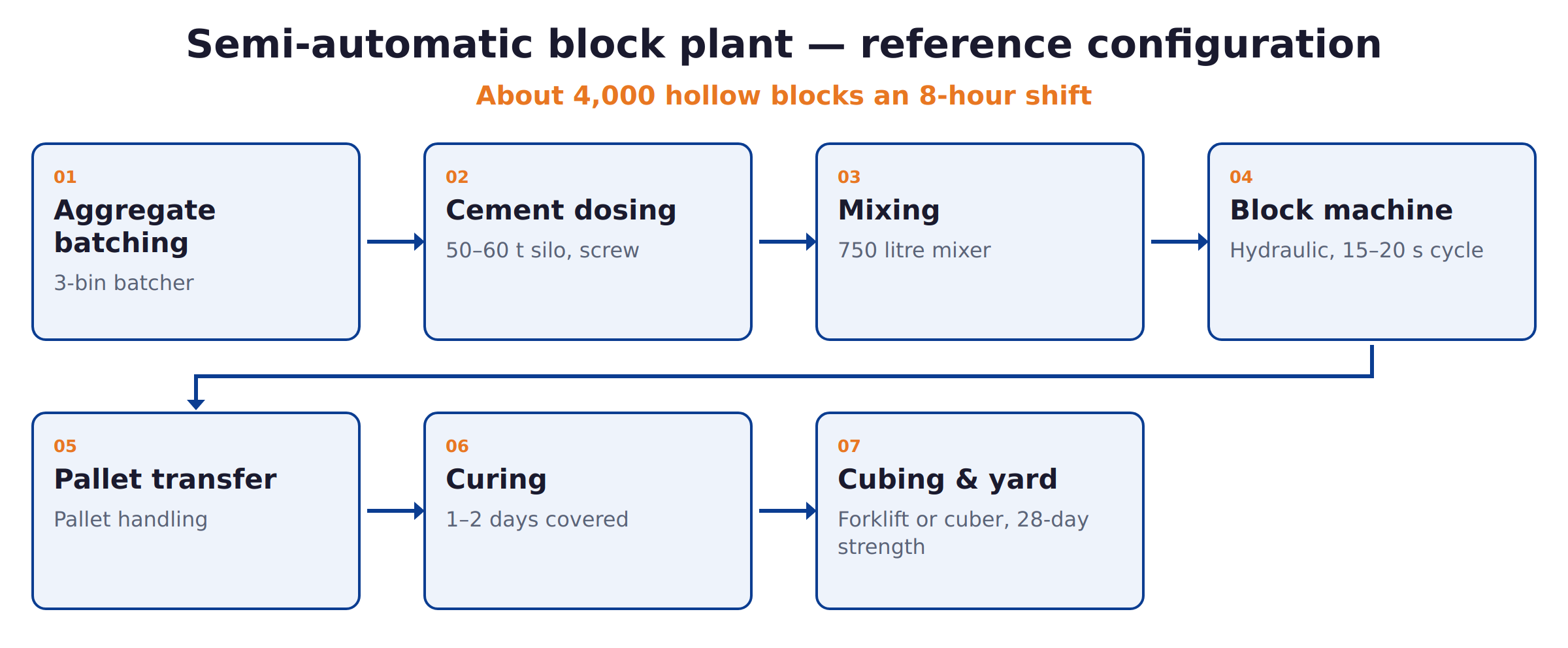
- Curing. Pavers must stay moist and protected after moulding. Small yards cover them with plastic; larger plants use curing chambers or covered racks.
- Stacking and cubing. After curing, pavers are stacked into cubes on transport pallets. A cuber automates this on large plants; small yards stack by hand.
Paver standards and buyers
SANS 1058 covers concrete paving blocks: strength classes, abrasion resistance, dimensional tolerances and appearance. Municipal and commercial contracts usually specify it, and many contractors ask for test results or certified product. The Concrete Manufacturers Association represents precast and paver makers and lists the relevant SANS specifications. Demand comes from municipalities, developers of malls and estates, homeowners and landscapers, and housing projects; Human Settlements' 2026/27 budget was R26.972 billion.
Choosing by scenario
- New paving business: an egg-laying machine or a small pallet machine with two paver moulds, a pan mixer and a covered curing area.
- Block yard adding pavers: paver moulds and a face-mix unit on an existing pallet machine, if its vibration and pressure are enough; check with samples.
- Supplier to municipal and commercial contracts: a semi-automatic or automatic plant with weigh-batching, colour dosing, controlled curing and testing to SANS 1058.
Landed cost: what else to budget
| Item | Notes |
|---|---|
| Concrete slab and yard | Production, curing and stock areas, drainage |
| Pallets | Enough for production plus curing time |
| Aggregates and cement | Consistent grading; washed sand for face mix |
| Pigments | Iron oxide colours, dosed consistently |
| Water and power | Three-phase supply for stationary plants |
| Forklift or crane truck | Moving cubes and delivering |
| Laboratory testing | Strength and abrasion tests |
How to compare quotes
- Pavers per shift for each shape, not machine cycles.
- Compaction system: vibration force and pressing.
- Face-mix unit included or not.
- Moulds included, and the price of extra shapes.
- Batching: weigh-batching and colour dosing.
- Pallets included, and how many.
- Curing and stacking scope.
- Installation, commissioning with your aggregates, and training.
- Spares: mould liners, vibrators, hydraulic seals.
- References of yards making SANS 1058 pavers on the same machine.
Worked example: a block yard adding pavers
A yard making hollow blocks on a stationary pallet machine gets repeated requests from contractors for driveway and estate pavers. The owner first checks whether the existing machine can make dense pavers: sample pavers are made with a paver mould and a richer mix, cured for a week, and sent for strength tests. The results show the vibration is not strong enough for consistent strength, so the yard buys a second machine designed for pavers, with a face-mix unit for coloured pavers and moulds for rectangular and interlocking shapes.
The yard also has to change how it works. Pavers need washed sand and a consistent stone grading, pigment dosed by weight rather than by scoop, and a covered curing area where boards stay damp for several days. Each batch is recorded and a sample from every day's production is tested. After a few months, the yard can show contractors test results against SANS 1058 and quote for municipal paving work, which pays more reliably than walk-in block sales.
Colour and consistency
Coloured pavers sell at better prices than grey ones, but only if every batch matches. Colour depends on the pigment dose, the cement colour, the sand, the water content and the curing conditions, so a change in any of them shows on the driveway. Plants that sell coloured pavers weigh pigment for every batch, keep sand and cement from the same sources where possible, and cure all pavers the same way. A face-mix unit, which presses a thin coloured layer onto a grey base, uses far less pigment for the same appearance. Keep a reference sample of each colour and compare production against it every day.
Common mistakes
- Using a block mix for pavers. Strength and abrasion fall short.
- No face mix on coloured pavers. Colour costs rise and appearance suffers.
- Too few pallets. Output is limited by curing time.
- No curing. Pavers dust and wear quickly.
- No strength tests. Contracts are lost.
Where CISH fits
We supply complete paver and block plants, batching, press, moulds, pallets, curing and stacking, from audited factories in China, sized to your products and output. CISH ships and clears the plant, installs and commissions it with output and paver quality demonstrated on your aggregates, and trains your team. For a single manual paver machine, a local supplier is usually the better buy.
For wet-cast versus pressed pavers and the numbers, see how to start a paving brick business.
Frequently asked questions
How much does a paving brick machine cost in South Africa?
As an indication for 2026, a manual or egg-laying machine with paver moulds costs about US$8,000–40,000. A semi-automatic pallet plant costs about US$120,000–450,000 landed and commissioned.
Can a block machine make paving bricks?
Often yes, with paver moulds, if its vibration and pressure are strong enough. Check with sample pavers tested for strength.
Which standard applies to paving bricks in South Africa?
SANS 1058 covers concrete paving blocks, including strength, abrasion and dimensions.
What is a face-mix layer?
A thin top layer of finer, often coloured mix pressed onto the paver, which gives a smooth, coloured face at lower pigment cost.
How long must pavers cure?
They must be kept moist and protected for the first days and gain strength over weeks. Plan curing space or chambers for your output.
Does CISH supply single paver machines?
We supply complete paver and block plants. For a single manual machine, a local supplier is usually better.