Making the tissue itself needs a paper mill, a much larger investment. Jumbo rolls are most of the cost: tissue base paper (heading 4803) carries a 5% general duty when imported, free from the EU, UK, EFTA and SADC, while finished toilet paper (4818.10) carries 20%, which protects local converters. The business is won on cost per pack, roll quality and delivery: spaza shops, wholesalers, cleaning suppliers, offices and institutions buy on price and reliability. Packs must show the correct quantity.
Step 1: understand the business
| Part | What it means for you |
|---|---|
| Raw material | Jumbo rolls of tissue base paper, bought locally or imported |
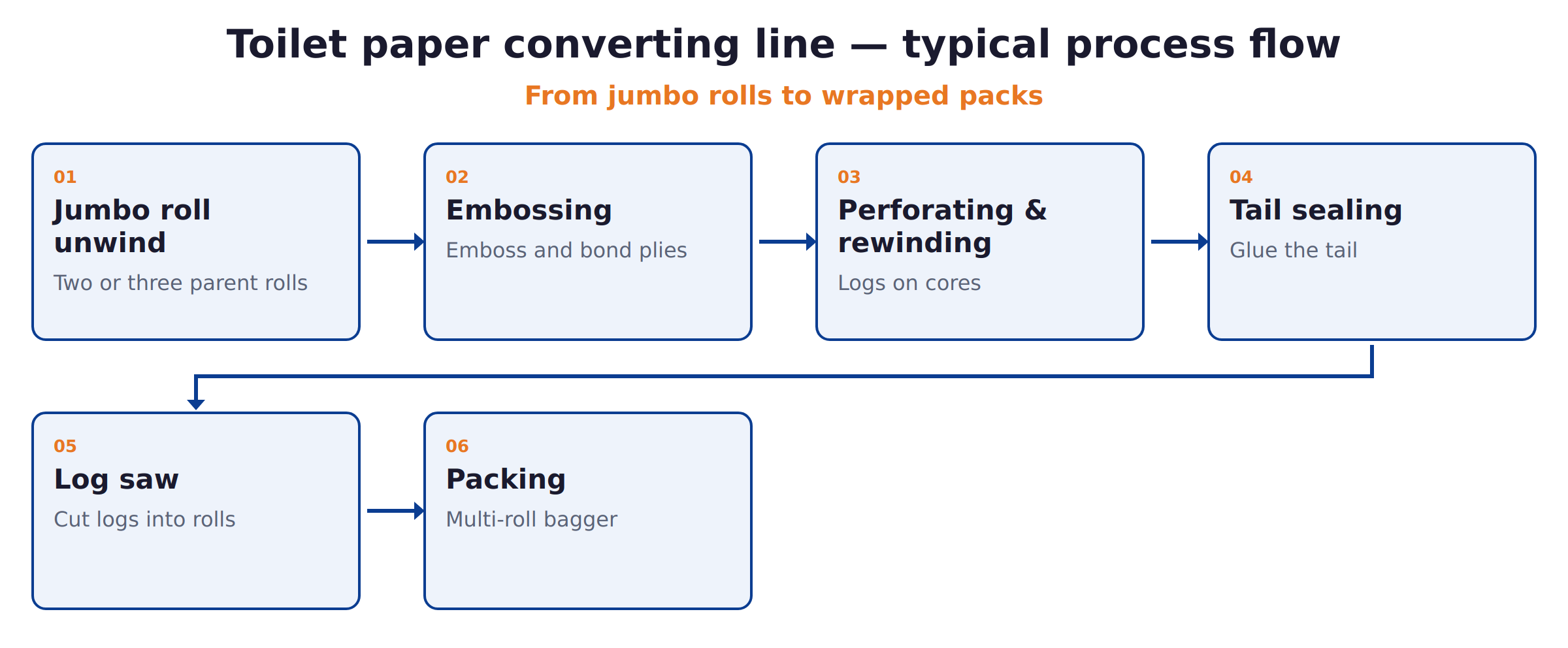
| Process | Rewinding, embossing, perforating, log cutting, packing |
| Product | 1-ply or 2-ply rolls, in packs of 1, 4, 9, 10, 18 or more |
| Customers | Spaza shops, wholesalers, hardware and convenience stores, offices, schools, hotels, cleaning companies |
| Competition | Large brands and imports; local converters compete on price and delivery |
Step 2: decide your product
- 1-ply rolls are cheaper and sell strongly in spaza shops and to institutions.
- 2-ply rolls are softer and sell in retail and offices.
- Sheet count and roll size: customers compare packs on price and how long a roll lasts; decide sheets per roll and roll diameter early.
- Recycled or virgin fibre: recycled-fibre jumbo rolls are cheaper and greyer; virgin fibre is whiter and softer.
Step 3: jumbo roll supply
Buy from local tissue mills or importers. Compare price per tonne delivered, grammage, softness, whiteness, roll width and diameter, and core size. As an example, a two-ply roll of 200 sheets of 10 × 10 cm at about 17 g/m² per ply uses roughly 68 g of paper, so one tonne of jumbo roll makes roughly 14,000–15,000 such rolls before trim and waste. Agree a supply contract and keep a few weeks of stock, because jumbo roll prices move with pulp prices and the exchange rate.
Step 4: equipment and costs
| Line class | Output | Indicative price (2026) |
|---|---|---|
| Manual or semi-automatic line | A few thousand rolls per shift | About US$10,000–50,000 (small line about US$25,000) |
| Automatic rewinder with semi-automatic cutting and packing | About 10,000–30,000 rolls per shift | Upper part of the starter band and above |
| Fully automatic line | Tens of thousands of rolls per shift | Up to about US$1 million |
You also need a core-making machine or bought-in cores, packing materials, a scale, and forklift or trolleys for jumbo rolls. Our toilet paper machine selection guide explains which step to automate first. Converting machines under 8441.10 and 8441.80 enter duty-free.
Step 5: premises and registration
A converting line needs a dry, clean building with three-phase power, floor space for jumbo rolls (which are large and heavy), the line and finished stock, and loading access for trucks. Register your company with CIPC, register for tax and, above the threshold, VAT. Toilet paper is not a food, so food premises rules do not apply, but buyers expect clean, dust-controlled production. Packs must show quantity in line with the Legal Metrology markings rules (SANS 289), usually as rolls and sheets per roll. Paper packaging and products may carry obligations under the EPR scheme for paper and packaging; check them.
Step 6: cost per pack
Add jumbo roll paper, cores, glue, packaging film or bags, labour, power, rent, transport and loan repayments, and allow for trim and start-up waste. Work out cost per roll and per pack for each product, then compare with shelf prices in the stores you will supply. A converter that buys paper well, keeps waste low, and runs full shifts makes the margin; one that runs half shifts on expensive paper does not.
Step 7: sell and deliver
Spaza shops and small wholesalers buy often and in small quantities, so a delivery vehicle and a route plan are part of the business. Offices, schools and cleaning companies buy in cases on account. Retail chains need barcodes, consistent quality and the capacity to supply many stores. Public institutions buy through tenders; register on the Central Supplier Database if you plan to bid.
Worked example: a township converter
A business in Soweto buys recycled-fibre jumbo rolls and makes 1-ply rolls of 350 sheets in single-roll and 10-roll packs on a semi-automatic line. It sells to about 120 spaza shops and three small wholesalers, delivering twice a week with one bakkie. After a year it adds 2-ply rolls in 9-roll packs for offices and convenience stores and an automatic log saw, because cutting had become the bottleneck. The figures are illustrative.
Common mistakes
- No jumbo roll contract.
- Loose or uneven rolls.
- Wrong sheet count on the pack.
- No delivery plan.
- A machine too fast for the sales.
Products beyond toilet paper
The same jumbo rolls and skills support other tissue products: kitchen towels, serviettes, hand towels for dispensers and large jumbo toilet rolls for offices and malls. Each needs its own converting machine, but they sell to the same wholesalers, cleaning suppliers and institutions. Adding a product for the away-from-home market, such as dispenser rolls for offices, can smooth out sales between retail peaks.
Quality checks
Check rolls every hour for sheet count, roll diameter, firmness, perforation and embossing quality, and weigh a sample of rolls against your target weight. Inspect packs for seal and print. Keep a few packs from each batch, labelled with the date and jumbo roll lot.
Staff and shifts
A semi-automatic line usually needs an operator on the rewinder, people moving and cutting logs, and a packing team. Train everyone on machine safety, especially around saws and rewinders, and run two shifts once sales justify it, because jumbo roll stock and the machine cost the same whether the line runs one shift or two.
Working capital
Jumbo rolls are paid for before the paper is sold, often in loads of several tonnes, and many wholesalers buy on account. Plan working capital for several weeks of paper, finished stock and customer credit, and track how fast spaza shops and wholesalers pay.
Fire safety
Paper and tissue burn quickly, and jumbo roll stores hold a large fire load. Keep extinguishers and hose reels close, keep aisles clear, store rolls away from heaters and electrical boards, and check your fire compliance with the municipality.
Where CISH fits
We supply complete toilet paper converting lines, rewinding, embossing, log cutting, core making and packing, from audited factories in China, sized to your rolls and packs. CISH ships, clears, installs and commissions the line on your jumbo rolls, and trains your operators. For a single used rewinder, a local seller is usually the better choice.
Another waste-paper business: see how to start an egg tray business in South Africa.
Frequently asked questions
How much does it cost to start a toilet paper business in South Africa?
As an indication for 2026, a manual or semi-automatic converting line costs about US$10,000–50,000, before premises, jumbo roll stock and working capital.
Where do I buy jumbo rolls?
From local tissue mills or importers. Imported tissue base paper carries a 5% general duty, free from the EU, UK, EFTA and SADC.
Is toilet paper manufacturing profitable?
It can be, if you buy paper well, keep waste low, run full shifts and deliver reliably.
Should I make 1-ply or 2-ply?
1-ply sells strongly to spaza shops and institutions; 2-ply sells to retail and offices. Many converters make both.
How many rolls come from a tonne of jumbo roll?
As an example, roughly 14,000–15,000 two-ply rolls of 200 sheets, depending on grammage and sheet size.
Does CISH supply toilet paper lines?
Yes, complete converting lines with commissioning and training.