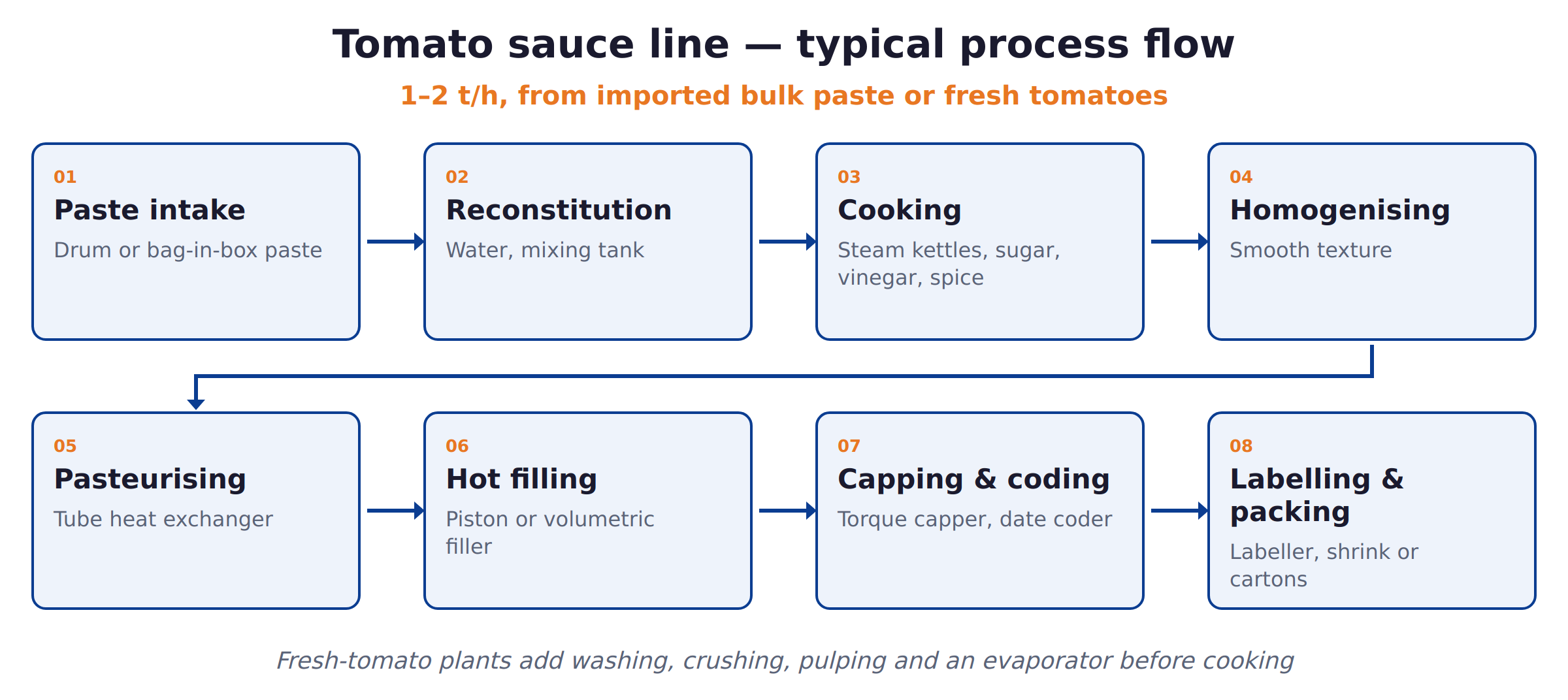
Tomato sauce production lines in South Africa are sold by food machinery dealers, local stainless fabricators who make cooking kettles and tanks, Chinese factories selling direct, and turnkey companies that design the full line from paste or fresh tomatoes to labelled bottles. Most South African sauce makers reconstitute imported bulk paste, which carries 37% general duty unless a rebate permit or trade agreement applies, so the supplier should design for your raw material.
Who sells tomato sauce lines
Sauce brands, chutney and atchar makers, farm processors and food manufacturers adding a sauce range all ask for tomato sauce lines. The market splits into four kinds of supplier.
| Supplier type | What they sell | Price | Who answers for output | Best fit |
|---|---|---|---|---|
| Food machinery dealer | Kettles, colloid mills, fillers, cappers, labellers | Moderate | The dealer, per machine | Small producers adding a machine |
| Local stainless fabricator | Jacketed kettles, mixing tanks, platforms | Lower for simple vessels | The fabricator, for its vessels | Tanks and kettles around imported machines |
| Chinese factory, direct | Paste reconstitution, cooking and homogenising, hot fill, complete fresh-tomato lines | Lowest on the quote | You, after delivery | Buyers with process engineers |
| Turnkey sauce line company | Mixing to palletised cartons, laid out and commissioned | Between direct and dealer | The turnkey company, at agreed tonnes per shift | New plants and first lines |
Paste or fresh tomatoes: decide first
| Reconstituting bulk paste | Processing fresh tomatoes | |
|---|---|---|
| Raw material | Drums or bags of paste, usually imported | Processing tomatoes from contracted growers |
| Main equipment | Mixing tanks, cooking kettles or a cooker, homogeniser, filler | Washing, sorting, crushing, hot-break, pulper-finisher, evaporator |
| Season | All year | Harvest season, with paste stored for the rest of the year |
| Capital | Lower | Much higher, especially evaporation |
| Main risk | Paste price and duty | Grower supply and the short season |
Fresh-market tomatoes and processing tomatoes are, as a national study put it, essentially two different tomatoes. A processing plant needs a grower base of the right varieties, not tomatoes bought from the fresh market.
What to check in the supplier
Cooking and consistency
Sauce is cooked, thickened and often homogenised for a smooth texture. Ask how the line controls Brix (solids), viscosity and cooking time, and how it avoids scorching in kettles.
Hot filling and sterilising
Most tomato sauce is hot-filled into PET or glass, then cooled. Ask for the filling temperature, bottle type, cooling tunnel length and how the line prevents spoilage between batches.
Cleaning and changeover
Sauce makers often run several products: tomato sauce, chutney, atchar, barbecue and chilli sauces. Ask how long a changeover and clean take on the filler and tanks.
Where to find sauce line suppliers
- Food processing trade shows in Johannesburg and Cape Town show kettles, mills and fillers; check current dates with organisers.
- The National Agricultural Marketing Council has published tomato value chain work that explains the processing industry.
- Running plants: visit one making a sauce and pack like yours.
- China: many paste and sauce lines sold in Africa are built in China. Our supplier audit checklist lists what to inspect before paying.
We do not name individual sauce line sellers.
How to choose: a 10-point checklist
- Raw material route: bulk paste, fresh tomatoes or both.
- Products and packs listed, with tonnes per shift for each.
- Mixing and cooking with Brix and viscosity control.
- Homogenising for smooth sauces.
- Hot filling, capping and cooling for your bottle.
- Labelling, coding and packing.
- Cleaning in place and changeover time.
- Utilities: steam boiler, cooling water, compressed air, power.
- Installation, commissioning on your recipe, and training.
- Spare parts and support for pumps, seals and filler valves.
Making atchar rather than sauce? See how to start an atchar business in South Africa.
Ten questions to ask
- What tonnes per shift does the line make for each sauce and pack?
- Is the line designed for paste, fresh tomatoes or both?
- How are Brix, viscosity and cooking time controlled?
- What filling temperature and bottle does the line use?
- Is a cooling tunnel included?
- How long does a product changeover take?
- What steam and power does the line need?
- Is installation, commissioning and training included?
- What spare parts come with the line?
- Where in South Africa can I see a line like this making sauce?
Comparing sauce line quotes
| Section | What each quote should state |
|---|---|
| Raw material handling | Drum tipping or fresh-tomato intake, washing, sorting |
| Mixing and cooking | Tanks or kettles, cooker, capacity per batch |
| Refining | Colloid mill or homogeniser |
| Fresh-tomato section (if any) | Crusher, hot-break, pulper-finisher, evaporator |
| Filling | Hot filler, capper, bottle sizes, speed |
| Cooling and packing | Cooling tunnel, labeller, coder, shrink or cartons |
| CIP | Cleaning unit and pipework |
| Utilities | Boiler, cooling, compressor |
| Installation and training | Engineer days, recipe trials |
| Owner's scope | Building, drainage, power, permits |
Put the quotes on one scope before you compare price. See the worked same-scope comparison.
Common mistakes
- Planning fresh-tomato processing without growers. Fresh-market tomatoes are not processing tomatoes.
- Forgetting the paste duty. It changes the cost of every bottle.
- Kettles without stirring or temperature control. Sauce scorches and varies.
- No cooling after hot fill. Colour and flavour degrade.
- Ignoring changeovers. Many products on one line lose hours each week.
Tomato sauce line prices in 2026
Indicative, in USD, from our tomato paste and sauce line cost guide:
| Purchase | Capacity | Indicative price (2026) |
|---|---|---|
| Small machine set | 100–500 kg/h | About US$10,000–50,000 ex-works |
| Paste or sauce line | 1–2 t/h | About US$50,000–200,000 ex-works |
| Industrial paste plant | 100–500 t of fresh tomatoes a day | About US$500,000–2 million |
| Mayonnaise, atchar, chutney or spice lines | Any | Quoted per configuration |
The paste market and duties in South Africa
- Paste duty. Tomato paste (2002.90) carries 37% general duty in SARS's 2026 tariff, but enters free from the EU and UK, EFTA and SADC.
- Rebate for manufacturers. Schedule 3 rebate item 304.07 allows full duty rebate on paste in large containers used to make food preparations, under a specific ITAC permit.
- China dominates supply. A national study found China supplied 74% of tomato paste imports in 2010, and a Chinese trade-data publisher recorded 12,402 tonnes of Chinese bulk paste shipped to South Africa in 2025.
- Two different crops. Fresh-market and processing tomatoes are different varieties grown for different buyers.
- Food premises. The plant must meet R638 of 2018 and hold a Certificate of Acceptability.
- Duty-free machinery, mostly. Food preparation machinery (8438.60), filling machines (8422.30) and boilers (8402) are free of general duty, while heat exchange units (8419.50) carry 15%. Import VAT of 15% is reclaimable by VAT vendors; see the import duty guide.
Where CISH fits
CISH is a turnkey sauce line company. We specify paste reconstitution or fresh-tomato lines from audited factories in China against your products and packs, ship and clear them, and install and commission the line with tonnes per shift demonstrated on your recipe, and your operators trained. We suit sauce brands building a first line or expanding. For a single kettle or filler, a local dealer or fabricator is often the better choice.
Frequently asked questions
Who sells tomato sauce production lines in South Africa?
Food machinery dealers, local stainless fabricators, Chinese factories selling direct, and turnkey companies that supply complete lines from paste or fresh tomatoes to packed bottles.
How much does a tomato sauce line cost?
As an indication for 2026, a small set for 100–500 kg an hour costs about US$10,000–50,000 ex-works, and a sauce line for 1–2 tonnes an hour about US$50,000–200,000.
Should I make sauce from paste or fresh tomatoes?
Most South African sauce makers reconstitute bulk paste, which works all year with lower capital. Fresh processing needs contracted growers and an evaporator.
What duty is charged on imported tomato paste?
37% general duty in SARS's 2026 tariff, with free entry from the EU and UK, EFTA and SADC. Manufacturers can apply for a rebate permit under Schedule 3.
Is sauce machinery duty-free?
Most food preparation and filling machinery is free of general duty, but heat exchange units carry 15%. Import VAT of 15% applies.
Does CISH sell single kettles or fillers?
No. We supply complete sauce lines, installed and commissioned. For one kettle or filler, a local dealer or fabricator is usually the better route.