Service milling needs little more than a hammer mill, a reliable power supply and a good location, and is common in rural areas. Grain is the biggest cost and the biggest risk: maize prices follow the JSE commodity market and the harvest, so buying, storage and working capital decide the business more than the machinery. All graded meal must meet GN R.63 of 2016 and be fortified, and maize meal is zero-rated for VAT. Large millers compete on price, so a small mill wins on location, freshness, service and local trust.
Step 1: choose your business model
| Service milling | Own meal for sale | |
|---|---|---|
| How you earn | A fee per bag or kilogram milled | Margin between maize cost and meal price, plus by-products |
| Equipment | Hammer mill, sometimes a dehuller | Cleaning, degerming, roller mills, sifting, fortification, packing |
| Working capital | Low | High: grain stock |
| Customers | Farmers, households, small traders | Spaza shops, wholesalers, retailers, schools, institutions |
| Licences | Food premises if you pack meal; business registration | Food premises, COA, graded and fortified meal, labels |
| Risk | Seasonal demand around harvest | Grain price, competition with large millers |
Many rural mills do both: service milling in the harvest months and their own unsifted or sifted meal the rest of the year.
Step 2: buying maize
Maize prices in South Africa are set off the JSE's commodity derivatives market and move with the harvest, the rand and regional demand. The Crop Estimates Committee publishes monthly production forecasts through SAGIS. Small millers buy from farmers, co-operatives, traders or silo owners. Plan:
- Storage: bags or silos for at least several weeks of milling, dry and protected from pests.
- Quality checks at intake: moisture, broken kernels, foreign matter and visible mould.
- Working capital: grain usually ties up more money than the machines.
- Buying rhythm: buying at harvest when prices are lower needs storage and finance.
Step 3: choose your grades
GN R.63 of 2016 grades maize meal by fat and fibre: super (fat below 2.0%), special (2.0% to below 3.0%), sifted (3.0% to below 4.0%) and unsifted (3.5% to below 4.5%). Super and special need degerming and roller milling; unsifted can be made on a hammer mill. Super, special, sifted and unsifted meal sold in South Africa must also be fortified, so a commercial plant needs a premix doser. Our guide to the best maize milling machine matches mill types to grades.
Step 4: licences and labels
- Food premises: a mill that packs meal for sale must meet R638 and hold a Certificate of Acceptability from the municipality.
- Labels and marking: GN R.63 sets how maize products are graded, packed and marked, including the grade name on the bag.
- Fortification: the fortification regulations set the vitamins and minerals and how they are declared.
- VAT: maize meal is zero-rated, which affects your pricing and VAT returns.
Step 5: equipment and costs
| Plant | Output | Indicative price (2026) | Space and staff |
|---|---|---|---|
| Hammer mill for service milling | 0.5–3 t/h | A small part of a plant budget | Small room, 1–2 people |
| Complete roller plant with packing | About 30 t/day | About US$250,000–400,000 | About 150–250 m², 3–6 people per shift |
| Complete roller plant | About 60 t/day | About US$700,000–1.1 million | About 400–600 m², 8–14 people per shift |
| Large plant | About 240 t/day | About US$2.0–3.5 million | Multi-storey mill |
Our maize mill sizing guide sets out what each size needs.
Step 6: by-products
A roller plant separates bran and germ. Germ and bran sell to feed mills and farmers as hominy chop or as separate products, and are an important part of the mill's income. Plan how you will bag and sell them from day one.
Step 7: power
Mills are heavy power users, and Eskom's standard tariff rose 8.76% for 2026/27. Check your supply capacity before ordering, use efficient motors, and plan backup for the critical motors and the packing line.
Step 8: sell
Large millers dominate supermarket shelves on price. Small and medium mills sell well through spaza shops, local wholesalers and independent stores in their area, to schools, hospitals and prisons through tenders, and to farmworkers and households through the mill shop. Fresh meal, local brand trust, reliable delivery and service milling for customers' own maize are the advantages to build on.
Worked example: a rural mill adding graded meal
A mill in the Eastern Cape offers service milling and sells unsifted meal in 10 kg and 25 kg bags from a hammer mill. Local shops ask for special meal. The owner adds silo storage for about three weeks of milling and plans a 30 t/day plant with cleaning, degerming, roller milling, sifting, a fortification doser and a bagging scale, keeping one hammer mill for service milling. Bran and germ are sold to nearby farmers. The plant runs one shift at first and moves to two when sales grow. The figures are illustrative.
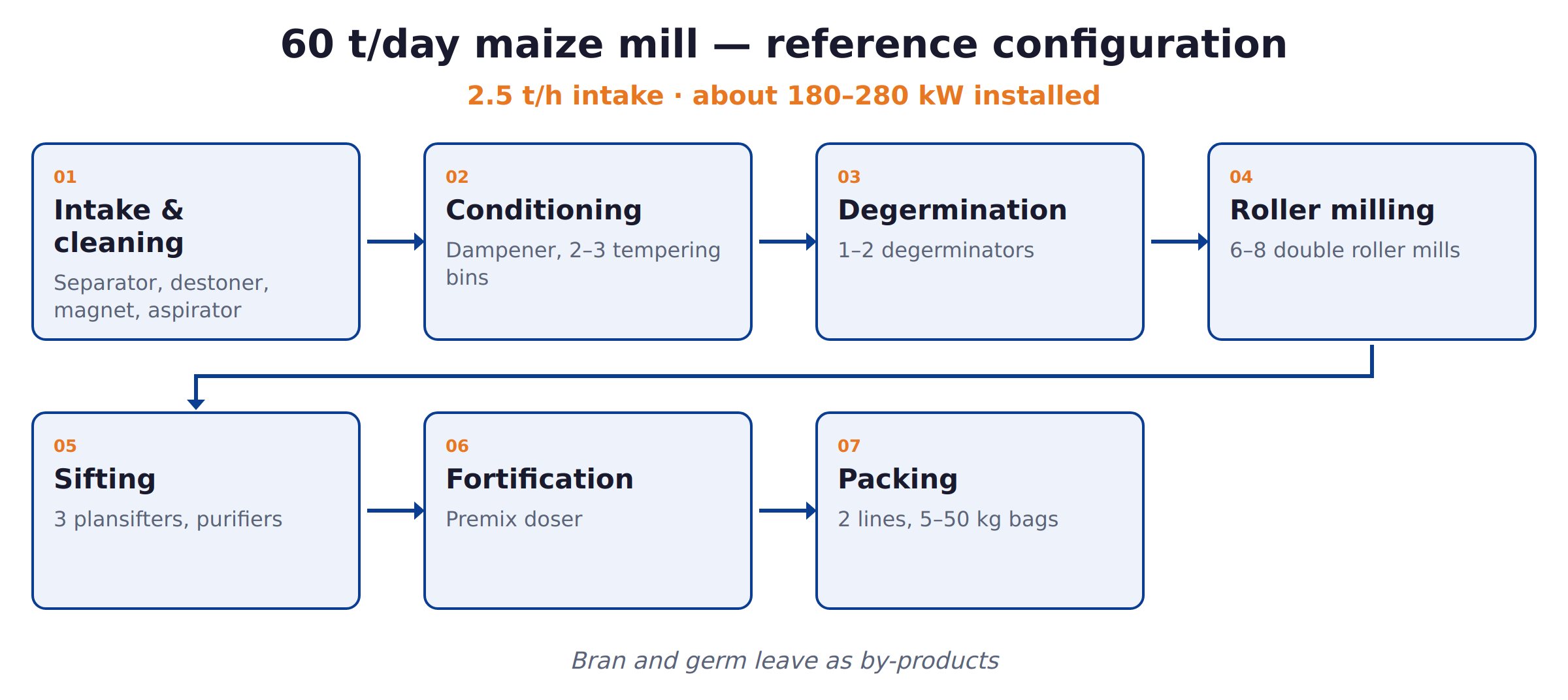
From a delivered project: On a delivered 60 t/day super-fine maize mill more than six hours from the nearest engineering hub, the mill itself was the easy part: extra pre-cleaning for maize at 11–16% moisture, an on-site critical-spares buffer and a year of support took the plant to about 85% of nameplate by month four. Read the maize mill case study.
Common mistakes
- No grain storage or working capital.
- Buying a hammer mill to compete on super meal.
- No fortification doser.
- Undersized power supply.
- No plan for bran and germ.
People and skills
A roller mill needs a trained miller who understands roll settings, sifting and extraction, supported by operators and a maintenance person who can change screens, belts and bearings. Train your miller during commissioning, and keep records of extraction rates and grades per shift. The National Chamber of Milling represents the milling industry, and training courses for millers are available through industry channels.
Quality checks in the mill
Check incoming maize for moisture and foreign matter, finished meal for fat and fineness against the grade, and fortification dosing by keeping a record of premix used against meal produced. Keep a retained sample from every batch for at least the shelf life of the product.
Bags and branding
Shoppers recognise maize meal by brand and bag colour. Print the grade, net weight, fortification statement, batch and your details on every bag, and keep the design the same across bag sizes so customers can find you on the shelf.
Where CISH fits
We supply complete maize milling plants, cleaning, degerming, roller milling, sifting, fortification and packing, from audited factories in China, sized to your grades and tonnes. CISH ships, clears, installs and commissions the plant on your maize, and trains your miller. For a hammer mill for service milling, a local supplier is usually the better buy.
Most meal leaves the mill in woven sacks; if you plan to make your own, see how to choose a PP woven bag machine supplier.
Service millers choosing a power source should read diesel vs electric hammer mills, with the energy cost per tonne worked out.
Frequently asked questions
How much does it cost to start a maize milling business?
Service milling can start with a hammer mill. A complete 30 t/day roller plant with packing costs about US$250,000–400,000 as an indication for 2026, before building, grain and working capital.
Is maize milling profitable in South Africa?
It can be, if you buy grain well, sell close to your mill, and use by-products. Grain price and competition from large millers are the main risks.
Does maize meal have to be fortified?
Yes. Super, special, sifted and unsifted maize meal sold in South Africa must be fortified.
Where do millers buy maize?
From farmers, co-operatives, traders or silo owners, at prices that follow the JSE commodity market.
Is VAT charged on maize meal?
No. Maize meal is zero-rated for VAT.
Does CISH supply small hammer mills?
No. We supply complete milling plants. For a hammer mill, a local supplier is usually better.